









Global Times
The awarding of the Fields Medal to Chinese mathematicians Deng Yu and Wang Hong has drawn widespread attention both in China and abroad, with the news becoming one of the top trending topics on Chinese social media.
The relevant topics such as “Wang is only 35 years old” and “Shing-Tung Yau hopes Wang Hong and Deng Yu will return to China to teach” gained about 1.6 million and 2 million views, respectively, on Chinese X-like Weibo platform on Friday.
Their personal journeys have also become a focus of online discussion. Some Chinese observers in the education sector said their personal achievements show that cultivating top-tier talent requires guiding students to integrate their interests and passions with their career development.
Both entered Peking University in 2007, but followed very different paths: Deng was admitted to PKU through a mathematics competition recommendation program and remained dedicated to mathematical research throughout his academic career; Wang entered university through the national college entrance examination, later transferred into mathematics, and briefly explored a different career path during her master’s studies, and eventually returned to mathematics, achieving world-class accomplishments, according to media reports.
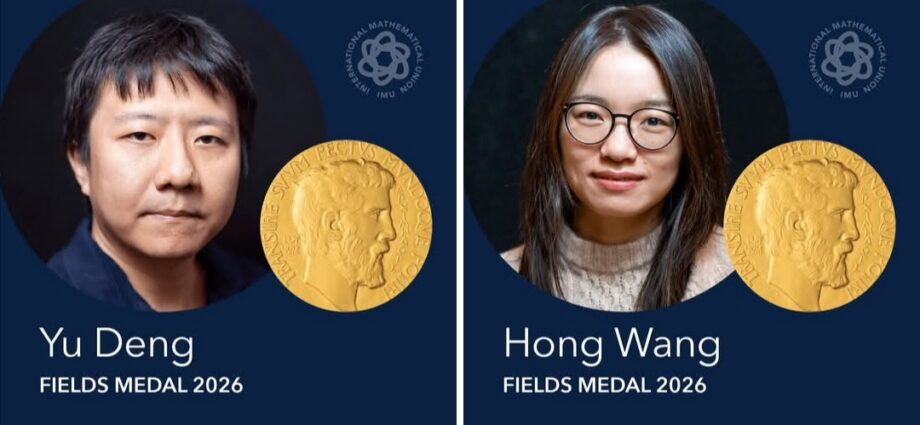
Deng and Wang were awarded the Fields Medals at the 2026 International Congress of Mathematicians opened here on Thursday, marking the first time Chinese mathematicians have won the prestigious honor, according to the Xinhua News Agency.
At the opening ceremony of the congress, held at the Pennsylvania Convention Center, the International Mathematical Union announced that Deng won the medal for his work in partial differential equations (PDEs), while Wang won the medal for her work in harmonic analysis and geometric measure theory, Xinhua said.
Born in 1991 in Guilin, South China’s Guangxi Zhuang Autonomous Region, Wang grew up in a family with a strong connection to mathematics – her father was a mathematics teacher, according to media reports.
When she was around five or six years old, before starting primary school, Wang received a mathematics textbook ahead of time. At the end of some chapters, the textbook included a box containing several brainteasers labeled “Think About It,” China Science Daily reported.
One of the problems asked: If there are seven trees, and every three trees in a straight line count as one row, what is the maximum number of rows that can be formed? Wang was thrilled when she figured out the answer. From then on, she developed a passion for using her mind to “think through” problems, the media report said.
“Fun” and “interesting” are the words Wang repeatedly uses when recalling her first encounters with mathematics.
During her middle school years, Wang did not have outstanding academic achievements and was not considered a “prodigy” by the public. She participated in a high school mathematics competition once, but only won an ordinary provincial-level award. In her first year of high school, Wang ranked outside the top 100 in her grade.
By her second year, she had improved to within the top 60. In her final year, Wang made a breakthrough, rising into the top 10 students in her grade.
In 2007, Wang Hong was admitted to Peking University at the age of 16 due to the time in primary school when she skipped two grades, marking the first major milestone of her life.
Born and raised in Shenzhen, Deng showed remarkable talent from an early age.
In his first year of junior high school, he came close to pursuing a professional career in Go, falling just one step short of qualification. At the age of 17, he won a gold medal at the International Mathematical Olympiad (IMO) and was admitted to Peking University through a recommendation program. Two years later, he transferred to the Massachusetts Institute of Technology (MIT) and went on to earn his PhD from Princeton University, according to media reports.
“Although they demonstrated different levels of mathematical talent during their middle school years, they shared one important trait: from the beginning of their undergraduate studies, they had set their sights on becoming professional mathematicians as a long-term career goal,” Xiong Bingqi, director of the 21st Century Education Research Institute, told the Global Times on Friday.
To continue cultivating more outstanding professional mathematicians, the key is to guide students to combine their intrinsic interests and long-term passion with their future career development, Xiong said.
Wang is now a permanent professor at the Institut des Hautes Études Scientifiques (IHES) since September 2025, where she is affiliated with the Alexander Grothendieck Laboratory (CNRS/IHES), according to the website of IHES. Wang is also a Silver Professor of mathematics at the Courant Institute of New York University (NYU) in the US.
In a phone call, the French President Emmanuel Macron congratulated Wang for the awarding, according to a Facebook post from the French leader on Friday.
“Educated at École Polytechnique and a researcher at the Institut des Hautes Études Scientifiques (IHES) in Paris-Saclay, she represents the excellence of our research and education system. A source of pride,” Macron said.
On Friday, news of the two Chinese mathematicians winning the award also drew widespread attention on Chinese social media. Among related discussions, the hashtag “Shing-Tung Yau hopes Wang Hong and Deng Yu will return to China to teach” became the top trending topic on Weibo.
Yau, was awarded the Fields Medal, at the age of 33, becoming the first Chinese recipient of this prestigious honor, per Xinhua.
Yau said he hopes that the younger generation of Chinese mathematicians who have grown up in China will be able to make their most important breakthroughs at home, forge their own path in mathematics, and help China become a leading global power in the field, according to media reports.
“I have always sincerely invited them to return to China to teach, and I hope they can help guide our students,” Yau was quoted as saying in the reports.
For students with an interest and talent in mathematics to grow into professional mathematicians, it is essential to create an environment that allows them to pursue their interests and career aspirations. The cultivation of top-tier talent should not be distorted by utilitarian considerations, Xiong noted.
“To achieve this, basic education and university selection and evaluation systems should adopt more diverse approaches – recognizing the talent demonstrated through competitions while also ensuring that students who start at a slower pace but steadily develop through genuine passion are not overlooked,” the Chinese expert said.