


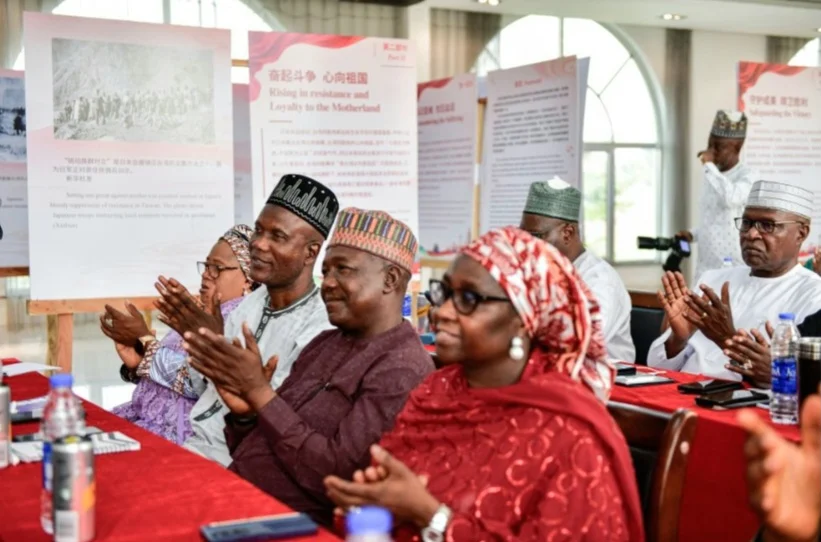
A photo exhibition to mark the 81st Anniversary of Taiwan’s Restoration to China was held friday in the Nigerian capital Abuja, bringing together diplomats, scholars, industry leaders and media practitioners from China and Nigeria.
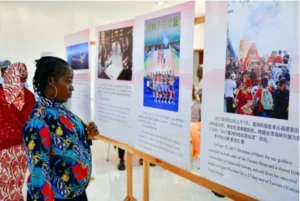
Organized by Xinhua News Agency Africa Regional Bureau in partnership with several organizations, the exhibition features four thematic sections and more than 30 photos under the theme “Remembering Taiwan’s Restoration, Advancing National Reunification.”
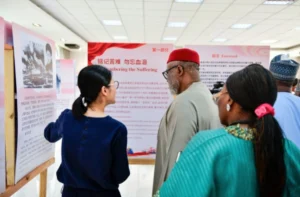
Yang Jianxing, cultural counselor of the Chinese Embassy in Nigeria, said the restoration of Taiwan was an important outcome of the Chinese people’s victory in the War of Resistance Against Japanese Aggression and part of the collective memory of the Chinese nation.
“The exhibition features a series of precious historical photographs and detailed textual records, showcasing the firm resolve of the Chinese people as a whole to uphold the one-China principle and safeguard national sovereignty, unity and territorial integrity,” Yang said.
Hu Jieguo, secretary-general of the China Council for the Promotion of Peaceful National Reunification in Western Africa, said Taiwan was liberated from Japanese colonial rule and returned to China 81 years ago.
“This victory was not a gift, but was paid for with the blood, sweat, and tears of millions of Chinese sons and daughters who stood united against foreign aggression,” Hu said, noting that the commemoration in Nigeria carries special significance as China and Nigeria share historical experiences of resisting foreign invasion and colonialism.
Gui Tao, deputy editor-in-chief of Xinhua News Agency Africa Regional Bureau, said the exhibition, held in five African countries including Kenya, Tanzania, South Africa, Nigeria and Mozambique, looks back at an important chapter of history and affirms peace, justice and historical fact.
“The African people, including the people of Nigeria, endured the suffering brought by colonialism, just as China did, and went through the same historical process of striving for national independence, state sovereignty and national dignity,” Gui said.
Three Taiwanese businesspeople from China’s Guangdong Province shared their experiences of working and living on the Chinese mainland through video.
Chen Chi-An, executive vice president of the Guangzhou Taiwan-Funded Enterprises Association, said there are more than 2,900 Taiwan-funded companies in Guangzhou, with many Taiwanese students also studying and living in the city.
“Over the past several decades, I have been able to give back to and work together with young people from the mainland, which is what makes us Taiwan businessmen happiest,” Chen said.
Wu Chun-Jui, president of the Taiwan Businessmen Association Dongguan, said Dongguan has a favorable business environment and that Taiwan businesspeople have established self-funded hospitals and schools there.
“We hope to take this opportunity to remember this period of history. The great rejuvenation of the Chinese nation is unstoppable,” Wu said.
Hsu Fu-hsien, president of the Taiwan Merchant Association Shenzhen, said he has worked in Shenzhen since 1990 and has built his family and career there.
“I have grown up here, got married here, and my children have also grown up here in Shenzhen,” Hsu said, expressing hope that the exhibition would allow African people and overseas compatriots to see the reality of Taiwanese businesspeople living and working on the Chinese mainland.
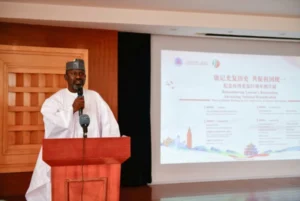
Sheriff Ibrahim, head of the Centre for Contemporary China-Africa Research in Nigeria, said Nigeria recognizes the one-China principle and that the Nigerian government has continued to reaffirm this position.
“There is a certain similarity between China’s efforts to maintain national unity and Nigeria’s own experience in maintaining its territorial integrity,” Ibrahim said, expressing confidence that China would eventually achieve peaceful reunification with Taiwan.
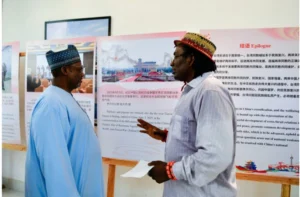
Charles Onunaiju, director of the Center for China Studies in Nigeria, said China’s experience of foreign intervention and colonial aggression is closely connected with the issue of national reunification.
“African countries have their own historical experiences and are therefore able to understand China’s position on safeguarding national unity and sovereignty,” Onunaiju said.
A book edited by Xinhua News Agency was also presented at the exhibition. The Taiwan businessmen associations from Guangzhou and Shenzhen donated books to Nigerian officials and experts. ■ (Xinhua/GSF)
Comments