


By our Correspondent
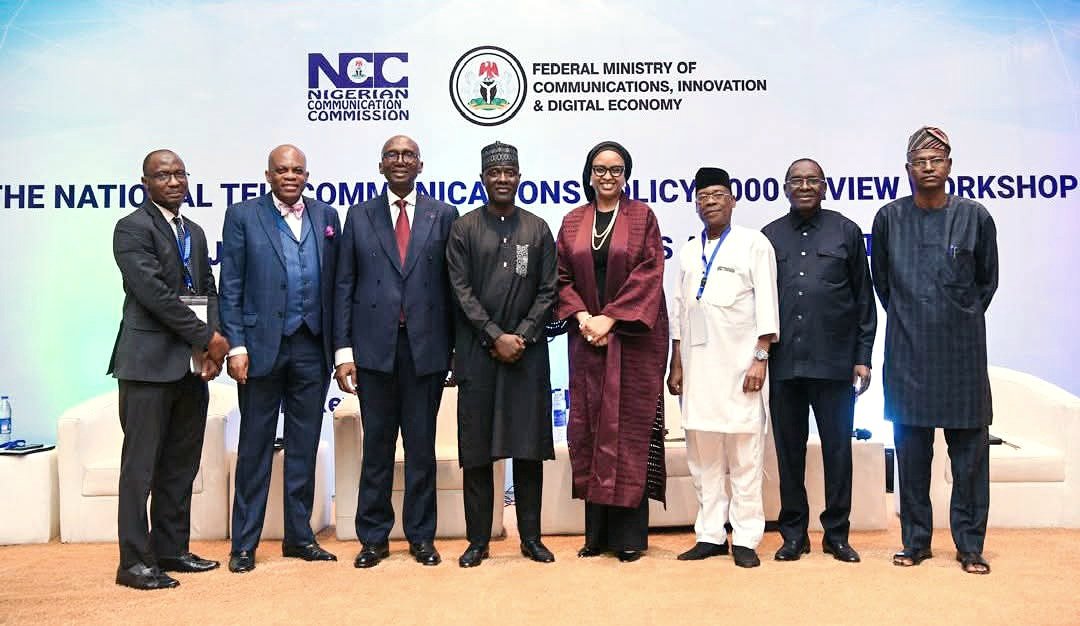
The Nigerian Communications Commission (NCC) has commenced a two-day Stakeholders’ Policy Review Workshop in Lagos, aimed at revising the National Telecommunications Policy (NTP) of 2000.
The workshop brings together key industry players to assess the sector’s journey over the past two decades, celebrate milestones, and chart a path forward for Nigeria’s digital future.

In his opening remarks, the Executive Vice Chairman/CEO of Commission, Dr. Aminu Maida noted that the communications sector has evolved from an isolated vertical into a foundational ecosystem. He stressed the need for robust policy frameworks to govern emerging technologies, including Artificial Intelligence (AI), Satellite Broadband, the Internet of Things (IoT), Critical National Information Infrastructure, Digital Sovereignty, Network Resilience, and Quality of Experience (QoE).
Citing GSMA data, Maida projected that strategic digitization of agriculture, manufacturing, transport, and trade could contribute an additional 2 per cent to Nigeria’s Gross Domestic Product (GDP). He added that such a transformation could unlock two million jobs and generate ₦1.6 trillion in tax revenue.
The NCC chief also emphasized that modern regulatory tasks must urgently expand to address cybersecurity, data governance, digital financing, and online safety.
Also, technical panel sessions at the workshop are exploring the evolution and legacy of the NTP 2000, strategies for bridging the digital divide, building a resilient future that balances innovation with security, and international best practices in telecommunications policy. Stakeholder feedback on the Commission’s published policy proposals is also being reviewed.
According to the NCC, the workshop is part of a collaborative effort to co-create a resilient, inclusive, and future-ready digital economy for all Nigerians.
Delivering keynote address, Hadiza Bala Usman, Special Adviser to the President Bola Tinubu on Policy and Coordination, declared that the 26-year-old policy no longer reflects the realities of a rapidly evolving digital economy.

According to her, telecommunications have outgrown its traditional role of voice communication and now underpins virtually every critical sector of national life.
“The National Telecommunications Policy 2000 was developed at a defining moment in Nigeria’s reform journey. It supported liberalisation, attracted investment and transformed telecommunications into one of Nigeria’s most dynamic economic sectors,” she said.
However, she stressed that the country now faces a vastly different reality.
“More than two decades later, Nigeria has changed. Technology has changed. The economy has changed. The expectations of citizens have changed,” Usman stated.
She argued that the policy review must move beyond cosmetic amendments and deliver a modern telecommunications framework capable of driving national development, digital governance and economic competitiveness.
“A policy is not merely a document. It is the expression of a country’s priorities and the basis through which government choices become measurable outcomes,” she said.
The presidential advisor warned that obsolete or poorly coordinated policies often create duplication of functions, weak implementation, and limited impact.
Usman outlined key priorities for the proposed framework to include broadband expansion, affordability of digital services, protection of telecom infrastructure, quality of service, innovation, cybersecurity, consumer protection, and digital inclusion.
She said the review aligns with President Tinubu’s Renewed Hope Agenda and the administration’s Eight Presidential Priorities, insisting that the exercise should be viewed as a national economic assignment rather than a routine sectoral review.
“The telecommunications policy review should not be approached only as a sectoral obligation. It should be understood as a national development assignment,” she said.
Usman suggested stronger collaboration among regulators, operators, investors, state governments, and security agencies, particularly on issues affecting fibre deployment and infrastructure protection.
According to her, telecom facilities must now be treated as critical national infrastructure. (GSF)



Comments