








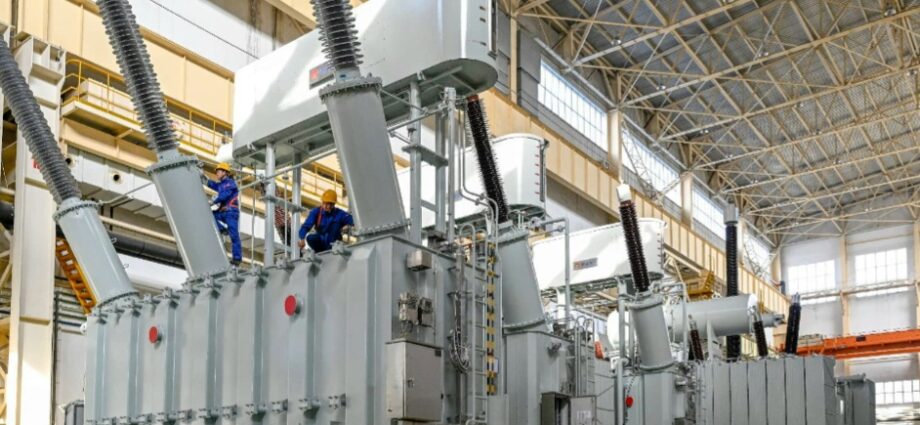
{BRNN/GSF} — Transformers, seemingly unremarkable devices, have recently become highly sought-after products worldwide.
According to China’s General Administration of Customs, China’s transformer exports exceeded 64.6 billion yuan ($9.29 billion) in 2025, up nearly 36 percent year on year. The average export price per unit reached about 205,000 yuan, roughly 1/3 higher than the previous year.
Many transformer manufacturers already have full order books, with some orders for data-center applications scheduled to run through 2027.
What drives this strong global demand for Chinese transformers? The most immediate factor is surging international need.
Developed economies such as Europe and the United States are upgrading aging power grids. Meanwhile, emerging markets face rising electricity consumption and increasing shares of clean energy power generation, accelerating investment in grid infrastructure. Concurrently, the rapid expansion of overseas computing infrastructure, including data centers, further fuels demand. These converging trends propel the growth of China’s transformer exports.
With numerous companies worldwide competing in this expanding market, why has China emerged as the world’s top transformer producer? Three key words hold the answer. Together, they explain not only why Chinese transformers are selling well, but also the deeper logic behind the global competitiveness of Chinese manufacturing sector.
First, “speed” — made possible by a highly integrated industrial chain.
The competitiveness of a product depends not only on the product itself but also on the industrial ecosystem behind it. China has established the world’s most comprehensive transformer manufacturing system, encompassing everything from raw materials like copper and aluminum to critical components such as transformer cores and on-load tap changers. This system accounts for roughly 60% of global production capacity.
Close coordination between upstream and downstream industries, together with a highly controllable supply chain, allows Chinese companies to respond rapidly to changes in demand. Their delivery times are often far shorter than those of European and American manufacturers, whose lead times typically range from 18 months to two years.
The advantages of a complete industrial system extend beyond transformers. In robotics, for example, China has steadily developed a comprehensive supporting ecosystem, from high-precision reducers and high-performance servo systems to intelligent controllers. Robots fully manufactured in the Yangtze River Delta now use 100 percent domestic core components, reducing costs by about 40 percent. In 2025, China’s exports of industrial robots exceeded imports for the first time.
Industrial competition cannot rely on isolated efforts. By leveraging its industrial scale and well-established supporting industries, China has built secure and efficient industrial and supply chains, enabling its enterprises to thrive in the global market and securing the strong foundation of Chinese manufacturing.
Second, “adaptability” — the ability to accurately identify and respond to market demand.
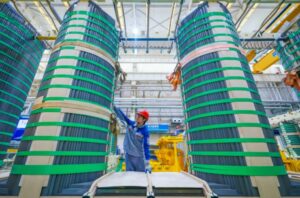
Innovation is reflected not only in technological upgrades but also in products that dynamically adapt to market needs. To satisfy environmental standards in European and American markets, Chinese companies have developed vegetable-oil transformers. For data center applications, they have designed solid-state transformers that occupy less space while offering higher efficiency. By focusing on market requirements and addressing specific customer needs through specialized and customized production, China’s transformer industry has grown rapidly.
Some foreign businesspeople remark that Chinese entrepreneurs have an exceptionally sharp eye for market opportunities: wherever demand appears, Chinese suppliers are often among the first to respond.
In the small appliance sector, multifunctional heaters, capable of warming a room on all sides while heating tea on top, have become popular in Japan and South Korea. In heavy machinery, cranes equipped with desert tires and special fire-extinguishing systems have gained popularity in Middle Eastern markets. These examples illustrate a simple principle: following the market and responding to demand can open wider global opportunities for Chinese manufacturers.
Third, “reliability” — supported by the vast and diverse application scenarios of Chinese market.
Application scenarios are valuable and often scarce resources for innovation. China’s domestic projects, from power grid upgrades to the construction of computing infrastructure, have provided transformer companies with real-world testing grounds to overcome technological challenges. Over the past five years, the State Grid Corporation of China has completed and put into operation “Eight AC and Eight DC” ultra-high-voltage (UHV) transmission projects, helping the country secure technological leadership in UHV transmission and intelligent transformers.
Diverse domestic scenarios, ranging from urban governance to logistics networks, are spurring the rapid development of low-altitude economy. Challenging environments such as high-altitude regions, deserts, Gobi and barren areas, and low-wind-speed zones have pushed wind power companies to develop customized technological solutions.
China’s enormous market size and rich application scenarios allow products to be tested extensively at home before entering international markets, ensuring both reliability and practicality.
Amid the uncertainties of a rapidly changing external environment, it is precisely these strengths — solid industrial foundations, strong innovation momentum and scenario-based advantages — that give Chinese companies the confidence to compete on the global stage.
They also highlight an important lesson: regardless of shifting market trends, companies that strengthen their capabilities, sharpen their competitiveness and continuously drive industrial upgrading will be well positioned to succeed in the long run.●