








Explainer: by Lawal Sale
Mobile Termination Rates (MTR), as explained, is the cost which one telecommunication provider incurs while terminating an incoming call from another telecom service provider.
Succinctly, whenever calls originate from one network provider and terminate in another, there would be a certain amount to be settled.
For instance, if a mobile phone user makes a call, the originating operator routes the call to the network of the person at the other end. In this case, the cost incurred by the other network is covered using the termination rates.
In essence, the review of the MTR, therefore, forms part of the pragmatic efforts of the Nigerian Communications Commission (NCC) to ensure that telecommunications services in the country are cost-effective, while pricing remains transparent, fair, and responsive to prevailing market conditions.
The outcome of the exercise is aimed at supporting the development of an appropriate regulatory framework for interconnection pricing and promoting effective competition, while stimulating efficient investments in telecommunications infrastructure and safeguarding consumer interests.
The NCC, therefore, regularly hosts stakeholder forums to determine and review Mobile Voice Termination Rates (MTR) and International Termination Rates (ITR) in Nigeria’s telecommunications industry. These regular engagements are specifically aimed at ensuring cost-based pricing, eliminating grey market activities (like call masking) and promoting healthy competition.
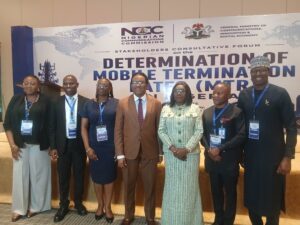
On June 16, 2026 the NCC, alongside a consultancy firm, KPMG, organized a stakeholders’ forum in Lagos, to examine relevant network, traffic, operational and financial parameters that are required for the development of a robust cost model for mobile telecommunication services and the determination of appropriate termination rates.
Expectedly, the discussions of the stakeholders were tailored towards the need to review the current termination rates which have been in place for more than eight years.
Major stakeholders, including the Association of Licensed Telecommunications Operators of Nigeria (ALTON), Association of Telecom Operators (ATCON), were all present to discuss balanced remuneration rates between the operators.
NCC’s Head of Competition and Tariff, Omotayo Mohammed, said that the review of the mobile termination rates was timely, adding that it was expected to support retail affordability in the telecom industry.
She emphasized that in Nigeria, the NCC, as the regulator, has made designed efforts to determine the rates so as to manage competition and ensure fair pricing across mobile network operators.
Mohammed maintained that the MTR review became essential because the existing rates no longer reflected prevailing economic and operational realities in the industry.
“The foundation of a wholesale interconnection affects every stakeholder,” she said.
Explaining further, the NCC official said that a maligned termination framework could enable an operator to foreclose a smaller competing operator, which would consequently deter infrastructure investments and in a worse-case scenario, burden consumers through inflated retail prices.
The current rates, as explained, stood at N3.90 per minute for generic operators and N4.70 per minute for new entrants. This arrangement, according to records, has remained unchanged for eight years.
Factors such as naira depreciation, soaring inflation, and increasing energy costs have combined to alter the operators’ pricing policy over the years.
The regulator noted that another factor that determined the network usage pattern has been the recent advancements in technology, particularly the deployment of 5G networks, the Artificial Intelligence (AI)-driven services and Internet of Things (IoT) applications, which also have adverse effects on network patterns beyond what was envisaged in the past.
Meanwhile, KPMG — the consulting firm which was engaged by the NCC to facilitate the rates review regime — has outlined the methodology for the study aimed at determining new MTR benchmarks.
In his presentation, at the forum, KPMG’s representative, Oluwole Adelokun, stressed that the study would focus on assessing the effectiveness of the current interconnection regime, while benchmarking Nigeria against international markets, so as to generate a sustainable framework for the growth of the country’s telecom sector.
Adelokun gave the assurance that KPMG, just like in the last rates review exercise, would sustain its collaboration with the NCC in efforts to achieve its objectives of promoting sustainable growth, competition and investment in the industry.
Four major key deliverables were identified by the consultancy firm. These include an independent assessment of the current interconnection regime and its impact on operators and consumers; a comparative analysis of international best practices; the development of a forward-looking cost model and recommendations for a revised pricing system. The firm’s study has also been divided into three phases which entail assessment, discovery and development strategies.
According to KPMG, telecom operators will be mandated to provide a comprehensive financial and operational information, covering a five-year period, in the areas of revenue, costs, profitability, market share, quality of service indicators, growth of investment and consumer usage metrics.
The firm underscored that the five-year data horizon was considered imperative in efforts to establish reliable trends and accurately assess the impact of the existing rates on market performance.
Perceptive industry stakeholders are of the view that the review of MTR and ITR comes at a time when there are significant changes within the sector.
While commending the NCC for convening the forum, Gbenga Adebayo, the Chairman of the Association of Licensed Telecom Operators of Nigeria (ALTON), described the MTR review as “fundamental to the health, sustainability and competitiveness of the industry”.
He added that that the positive impact of the Commission’s intervention was already evident in the sector.
Besides, the representative of the Association of Telecom Operators in Nigeria (ATCON), Dr. Chidi Ibis, lauded the NCC for bringing stakeholders together to participate in the MTR study, describing it as a very important exercise.
The ATCON chief noted that since the last review in 2018, the sector had witnessed unprecedented and rapid changes, saying that the telecom market had also undergone considerable transformation, which reflected in swift expansion, shifting market dynamics and deployment of advanced technologies such as 5G, and the emergence of new ecosystem players, including Mobile Virtual Network Operators (MVNOs).
NCC’s Director of Public Affairs Nnenna Ukoha described the forum as one of the commission’s most important and ambitious engagement with the larger stakeholders, noting that the review outcomes would impact positively on the entire telecommunications industry.
Ukoha reiterated that mobile termination rates were central to pricing structures, competition, service quality and consumer experience, thereby making broad stakeholder participation essential in the review process.
According to her, the active engagement of all stakeholders reflects not only the relevance of the forum’s agenda but also a shared commitment to the sustainable growth and development of Nigeria’s telecommunications sector.
All in all, the Commission led by the Executive Vice Chairman, Dr. Aminu Maida Commission assured all the stakeholders that it will continue to embrace collaboration and incorporate stakeholders’ feedback into its regulatory system, while ensuring a resilient, inclusive, and future-ready telecommunications sector.
— Lawal Sale is an Abuja-based Global Affairs Analyst and the Publisher of the Global South Focus online