


Xinhua
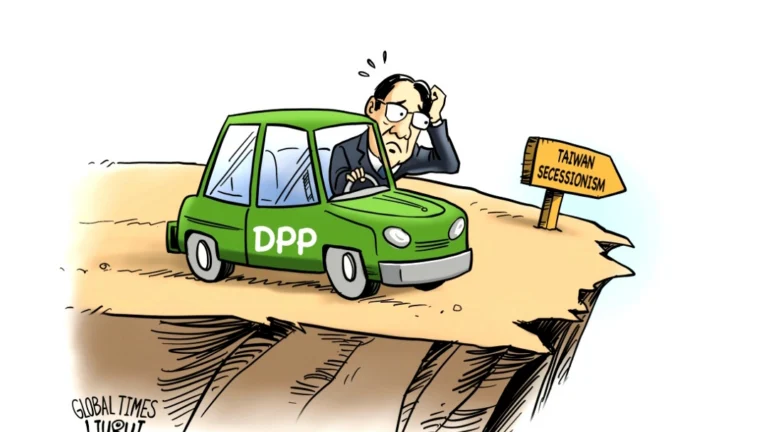
Mainland Taiwan affairs experts said the speech delivered on Saturday by Taiwan leader Lai Ching-te in Taipei is filled with deception, noting that his refined rhetoric cannot conceal his push for separatism.
Chen Guiqing, a research fellow at the Beijing-based Institute of Taiwan Studies, Chinese Academy of Social Sciences, said that Lai paid lip service to peace and cross-Strait exchanges, while repeatedly attacking and vilifying the mainland, groundlessly accusing it of applying pressure through military and “gray zone” actions and of attempting to alter the status quo in the Taiwan Strait.
“The remarks fully expose Lai’s stubborn separatist mindset and his intention to incite confrontation across the Strait,” Chen added.
Chen pointed out that facts have repeatedly shown Lai and the Democratic Progressive Party authorities as the source of undermining cross-strait stability and social harmony in Taiwan.
“Lai’s speech skirted the economic and social challenges facing Taiwan,” Chen said. “The remarks were apparently designed to serve the DPP’s interests in the upcoming local elections.”
The Taiwan question originated from a civil war fought between the forces led by the Communist Party of China and the Kuomintang about eight decades ago. In 1949, the defeated KMT retreated to Taiwan, while the People’s Republic of China was founded under the leadership of the CPC.
The unresolved civil war and foreign interference have left both sides of the Taiwan Strait in a prolonged state of political confrontation. However, the fact that Taiwan is an inalienable part of China’s territory has never changed.
Both history and reality make clear that Taiwan’s future should be jointly decided by all Chinese people, including Taiwan compatriots. Differences in political systems are neither an obstacle to China’s reunification nor an excuse for splitting the country.
Liu Xiangping, an expert on Taiwan studies at Nanjing University, said Lai’s hyping of “whole-of-society defense resilience” is essentially a pretext for increasing the island’s defense budget and a way to rationalize dragging Taiwan residents onto his separatist chariot.
“Lavishing the people’s hard-earned money on military expansion at the expense of their livelihoods will ultimately backfire,” Liu said.
Liu criticized Lai’s attempt to curry favor with the United States and the West. “By parroting Western ideological rhetoric, Lai has fully exposed his eagerness to act as a pawn for external forces,” the expert said.
Lai said he would “never allow the distortion of World War II history.” Yet his own words have repeatedly distorted history, said Wang Yingjin, director of the cross-Strait relations research center of Renmin University of China.
Wang noted that on the 80th anniversary of Taiwan’s restoration to China, Lai sided with the Japanese invaders by describing the victory in the War of Resistance against Japanese Aggression as merely the “end of the war,” which itself distorts the history of WWII.
Comments