


DEMOGRAPHY, DESTINY AND DISORDER
A Malthusian-Ricardian Reply to Nigeria’s Population, Land and Urban Planning Question

By Tanimu Yakubu
(Director-General, Budget Office of the Federation)
30 June 2026 | Revised 4 July 2026
This note responds to the proposition that Nigeria’s most urgent challenge is not population growth by itself. It is population growth without matching growth in productivity, formal work, food systems, infrastructure, urban order, security, municipal discipline and state capacity.
The argument is simple. Malthus warns about mouths without means. Ricardo warns about land without elasticity. In Nigeria, the two warnings now meet in the farm, the highway, the forest, the city drain and the green reserve that should never have been sold.
A child is not a curse. A child is a duty. A young population is not a disaster. It is raw power. But raw power must be educated, fed, skilled, housed, protected and employed. Otherwise it becomes pressure. Then pressure finds land. Land finds rent. Rent finds influence. Influence bends planning. And the public pays.
1. The Population Contrast
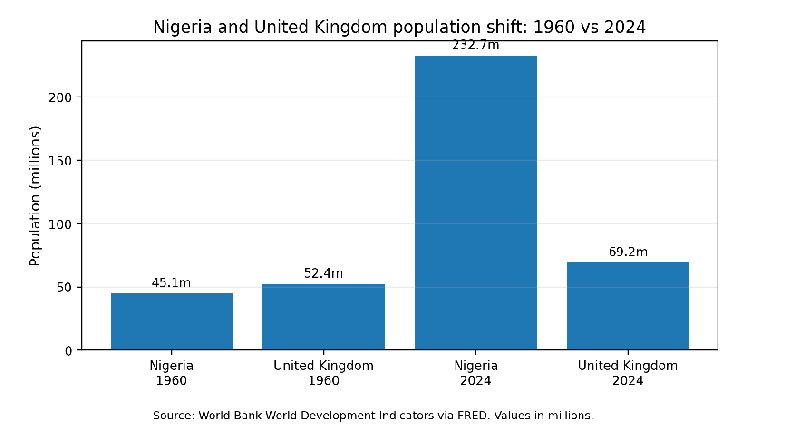
At independence in 1960, Nigeria’s population was 45,053,782. The United Kingdom’s population was 52,400,000. The two countries were not far apart in number.
By 2024, Nigeria had risen to 232,679,478. The United Kingdom stood at 69,226,000. This is not a small change. It is a demographic rupture. It is not pride. It is not shame. It is arithmetic. But arithmetic without policy becomes pressure. [1] [2]
The comparison is important because it shows the size of Nigeria’s opportunity and the size of its burden. A large population can build a market. It can defend a country. It can staff factories, farms, ports, schools, clinics, digital platforms and research laboratories. But it can do these things only when the state turns population into capability.
Figure 1: Nigeria and United Kingdom population shift, 1960 versus 2024. Source: World Bank World Development Indicators via FRED.
Population Data Used in the Chart
| Country | Year | Population |
| Nigeria | 1960 | 45,053,782 |
| United Kingdom | 1960 | 52,400,000 |
| Nigeria | 2024 | 232,679,478 |
| United Kingdom | 2024 | 69,226,000 |
2. The Income Per Head Contrast
Population shows the scale of the Republic’s burden or opportunity. GDP per capita shows the extent to which that population has been converted into economic value.
In 1960, Nigeria’s GDP per capita was US$93.14. The United Kingdom’s was US$1,397.59. By 2024, Nigeria stood at US$1,084.16. The United Kingdom stood at US$53,246.37. In relative terms, the United Kingdom moved from about 15 times Nigeria’s income per head in 1960 to about 49 times in 2024. [10] [11]
This is the deeper warning. The divergence is not merely between population counts. It is between population pressure and productivity per person.
These figures are stated in current U.S. dollars. They are therefore affected by inflation, exchange rates and national-accounts revisions. They are used here as a clear international dollar comparison, not as a complete measure of welfare or productivity.
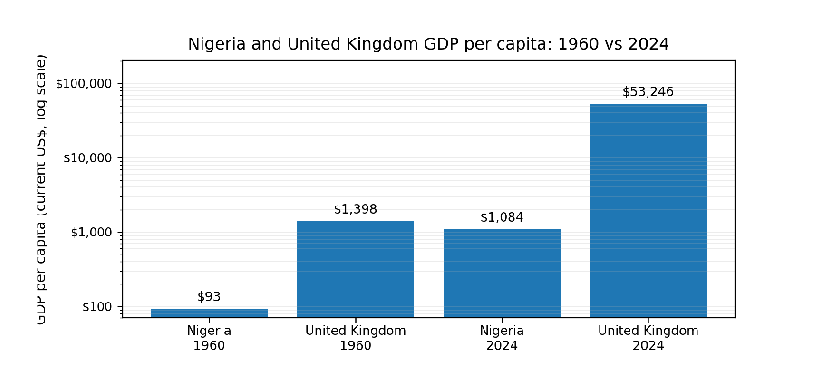
Figure 2: Nigeria and United Kingdom GDP per capita, 1960 versus 2024. Source: World Bank World Development Indicators via FRED. Current U.S. dollars; log scale used.
GDP Per Capita Data Used in the Chart
| Indicator | 1960 | 2024 |
| Nigeria GDP per capita (current US$) | 93.14 | 1,084.16 |
| United Kingdom GDP per capita (current US$) | 1,397.59 | 53,246.37 |
| United Kingdom / Nigeria ratio | 15.0x | 49.1x |
3. Malthus: Population Pressure and Social Misery
Malthus enters the Nigerian conversation with a hard warning. Beware the society where human multiplication outruns the means of dignified subsistence.
He was not saying that children are a curse. He was saying that when population grows faster than the productive base, society begins to impose cruel corrections. Hunger corrects. Disease corrects. Violence corrects. Migration corrects. Crowding corrects. Criminality corrects. Breakdown corrects.
Nigeria can see these corrections already. They are visible in the alleyways of our cities, where young men and women improvise livelihoods because formal work is scarce. They are visible in informal settlements pressing against old masterplans. They are visible on highways where insecurity feeds on unemployment. They are visible in forests where land hunger, criminal opportunity and weak state presence now meet.
The warning is no longer theoretical. Violence has entered the economics of food. Abductions for ransom have become a tax on movement, farming, schooling and trade. In several farming belts, the farmer does not first ask what to plant. He first asks whether the road, the village, the farm and the harvest route are safe.
Grazing lands and pastoral routes have also been disrupted, abandoned or militarised by fear. The result is a harsh Malthusian-Ricardian fusion: mouths multiply, productive land retreats, and insecurity begins to determine what the nation eats. [6]
Contemporary reporting links banditry and kidnapping for ransom in the North West to attacks on farmers, destruction of crops and food stores, levies on harvests and farm abandonment in parts of the North Central. Recent reporting also shows the wider collapse of state presence in ungoverned spaces, with gangs using forests and abandoned settlements as theatres for abduction, cattle rustling, extortion and survival politics. [7]
4. Ricardo: Land, Rent and the Limits of Territory
Ricardo adds a second warning. Land is not infinitely elastic. Land does not stretch because people need it. It does not become fertile because the population has grown. It does not become safer because the city has expanded.
As population grows, people press harder upon land. Cultivation moves from the better lands to poorer, more fragile, more distant and more conflict-prone margins. Rents rise. Land disputes sharpen. Farms fragment. Pastoral pressure deepens. Forests are encroached upon. Ecological spaces become theatres of survival and violence.
This Ricardian drama is already unfolding in Nigeria. Our farms are numerous but too often unmechanised. Our forests are vast but too often ungoverned. Our cities expand but too often without transport, sanitation, drainage, affordable housing or municipal finance.
Therefore, the issue is not whether Nigeria has people. The issue is whether Nigeria has converted its people into productive power. The issue is also whether Nigeria has the courage to govern land before rent-seeking governs it.
5. The City as a Malthusian-Ricardian Frontier
Ricardo’s theory of rent helps explain not only the farm. It also explains the Nigerian city.
Urban land is fixed. Population is not. Households multiply. Migration increases. Commerce deepens. Incomes change. Demand rises for serviced and well-located land. Then the price of land climbs. Once land value climbs, the rent seeker enters the story.
The rent seeker sees what the planner sees, but with a different eye. The planner sees a green belt. The rent seeker sees saleable plots. The planner sees a floodplain. The rent seeker sees foundations. The planner sees a drainage corridor. The rent seeker sees a row of shops. The planner sees a low-density district. The rent seeker sees flats, hotels, offices and gates.
This is why the Nigerian city has become a frontier. It is the place where Malthusian pressure and Ricardian rent now meet. The poor arrive in search of survival. The middle class seek housing. The powerful seek scarcity value. Municipalities seek revenue. Politicians seek patronage. Developers seek title. The drain, the farm, the setback, the green area and the old masterplan are left to defend themselves.
6. Open Land Is Not Idle Land
One of the most dangerous errors in urban governance is the belief that open land is idle land. It is not.
A green area has work to do. It cools the city. It absorbs water. It gives children air. It gives older people rest. It gives the future a reserve. A floodplain has work to do. It receives water when rain becomes heavy. A drainage channel has work to do. It carries water away from homes, markets, schools, clinics and roads. A setback has work to do. It protects access, safety, visibility and future expansion.
These spaces look empty only to the impatient eye. In truth, they are public ecological capital. They are part of the city’s hidden balance sheet. When they are sold, carved out, fenced, built over or regularised after violation, the city loses value even when private wealth is created.
The developer gains a building. The community loses a drain. The individual gains a title. The public inherits a flood. The powerful obtain an asset. The city pays through road damage, disease, displacement, emergency expenditure and civic anger.
7. The Dual Abuse: Demographic Pressure and Rent-Seeking Misdemeanour
The abuse of urban planning in Nigeria usually has two parents. The first is demographic pressure. The second is rent-seeking misdemeanour.
Demographic pressure creates demand. Demand creates scarcity. Scarcity creates rent. But rent-seeking misdemeanour converts that economic pressure into planning disorder. It is not population growth alone that destroys the plan. It is population growth meeting weak enforcement, elite privilege and administrative surrender.
The pattern is familiar. A city expands. Serviced land becomes scarce. Low-density neighbourhoods become valuable. Green spaces become tempting. Farms at the edge of the city become speculative assets. Someone builds first. Someone gets protection. Someone waits for regularisation. The municipality protests weakly, or not at all. After the buildings rise and people move in, the same municipality is asked to provide roads, drains, water, electricity, waste collection, schools, clinics, police posts and Certificates of Occupancy.
This is how illegality becomes policy by aftermath. This is how the violator is rewarded and the neighbour is taxed. This is how planning is killed twice: first by the illegal conversion, and then by the official service that makes the conversion permanent.
8. Low-Density Areas and the Arithmetic of Betrayal
A low-density district is not merely a place with big plots. It is an economic promise. The promise is quiet streets, lighter traffic, lower pressure on drainage, more open space, lower sewage loads, easier parking, greater privacy, better airflow and a planned relationship between land use and infrastructure.
When a low-density area is quietly converted into medium- or high-density use without infrastructure upgrade, that promise is broken. The new development takes the benefit of old public planning but refuses the cost of new public pressure.
A single carved-out plot may look small. One hundred such plots create a new city inside the old city. The road remains the same. The drain remains the same. The water line remains the same. The school remains the same. The police patrol remains the same. But the burden has doubled or tripled.
This is not development. It is density without responsibility. It is private gain built on public stress. It is the private capture of Ricardian land rent under demographic pressure.
9. Floodplains, Waterways and the Revenge of Water
Water does not obey influence. Rain does not respect title deeds. A blocked channel will speak in the language of flood.
When buildings rise on waterways, floodplains, natural drains, wetlands and green reserves, the city may look richer for a short while. Then the first serious rain comes. The water asks for its old road. If the old road has been sold, the water takes a new road. It enters compounds. It cuts streets. It destroys pavements. It carries refuse. It spreads disease. It displaces families. It damages vehicles, shops, schools and clinics.
The harm is not borne by the developer alone. It is borne by nearby communities whose interests were not considered when the land was converted. The neighbour who obeyed the plan pays through flooding. The school pays through blocked access. The market pays through poor drainage. The landlord pays through reduced property value. The tenant pays through rent increases and service charges. The municipality pays through emergency works. The public pays through preventable disaster.
In Ricardian terms, this is the conversion of public ecological value into private rent. In Malthusian terms, it is the compression of more bodies into less safe space. In governance terms, it is a warning that the state has allowed private appetite to overrule public purpose.
10. When Farms Become Estates
The city does not only attack itself. It also eats its food belt.
Across expanding municipalities, farms at the edge of town are increasingly converted into housing estates. Some conversions are lawful and planned. Many are not. The pressure is understandable. Families need homes. Developers seek land. Landowners seek value. Municipalities seek rates. But the public question is larger than the private transaction.
A peri-urban farm is not merely empty land waiting for blocks and roofs. It may be a source of vegetables, grains, poultry, livestock, employment, groundwater recharge, open space and local food security. When such farms are converted without planning, the city loses nearby food production and gains future congestion.
The consequences travel outward. Farmers are displaced or priced out. Food must come from farther away. Transport costs rise. Informal settlements appear on the edges of new estates. Old rural roads carry urban traffic. Streams are diverted. Schools and clinics are overwhelmed. Land disputes multiply. Those who lived near the farms are rarely consulted, yet they inherit the burden.
Then comes the final irony. After the farms have become estates, municipalities are asked to provide Certificates of Occupancy and amenities. Roads must be graded. Drains must be cut. Electricity must be extended. Water must be found. Waste must be collected. Security must be supplied. What began as private speculation becomes a public obligation.
11. Certificates of Occupancy After the Event
A Certificate of Occupancy should be a gate. It should not be an apology.
The Land Use Act vests significant land-administration powers in the Governor, including the grant of statutory rights of occupancy and Certificates of Occupancy, and restricts alienation of statutory rights of occupancy without the Governor’s consent. The Nigerian Urban and Regional Planning Act provides a framework for physical planning, development plans, development control and protection of the environment from disorderly development. [8] [9]
In principle, title and development should follow lawful allocation, planning permission, environmental safeguards and public-interest review. In practice, where the powerful build first and regularise later, the sequence is reversed.
Illegality then becomes the path to legality. Influence becomes an alternative to compliance. A document meant to certify lawful occupancy becomes a receipt for power. The municipality is left to adjust itself to a violation it should have prevented.
This is a deep injury to public order. It teaches citizens that obedience is foolish. It tells the planner that the plan is negotiable. It tells the developer that speed and influence beat law. It tells the community that its drainage, safety, quiet, access and health can be sacrificed without consent.
12. The Communities That Pay
The greatest injustice in planning abuse is that the victims are often absent from the transaction. They are not present when the land is carved out. They are not present when the density is raised. They are not present when the floodplain is fenced. They are not present when the farm is sold. They are not present when the retrospective title is granted.
Yet they pay.
They pay through flooding when drains are blocked. They pay through traffic when roads built for one density carry another. They pay through sewage overflow when the number of homes outruns the pipes. They pay through polluted wells and stagnant water. They pay through heat when trees and open spaces disappear. They pay through noise, parking pressure, waste accumulation, loss of recreation space and higher insecurity.
They also pay through money. Their property loses value when the neighbourhood becomes congested. Their service charges rise when estates demand private water, private power, private drainage and private security. Their children travel farther when schools are overcrowded. Their businesses lose time in traffic. Their municipalities divert scarce funds from planned expansion to emergency repairs created by unlawful conversion.
This is why planning abuse is not a technical offence. It is a social transfer. Wealth moves to the converter. Cost moves to the community. Title moves to the violator. Risk moves to the public.
13. China and India: When Demography Becomes Power
China and India teach the same lesson in different accents. Population size is not destiny. Population quality is strategy.
China did not become a global economic force merely because it had many people. It organised its population into labour, labour into manufacturing, manufacturing into exports, exports into reserves, and reserves into infrastructure, technology and national capability. Since 1978, China averaged over 9 percent annual GDP growth for decades and lifted almost 800 million people out of extreme poverty. The World Bank also notes that this growth relied heavily on investment and export-oriented manufacturing, even as China now confronts ageing and a declining labour force. [3]
India also has not grown merely because it is populous. Its demographic dividend has been mediated through services, technology, entrepreneurship, pharmaceuticals, digital public infrastructure, education, diaspora networks and a huge internal market. The World Bank states that India’s economy has nearly quadrupled in real terms since 2000, but it also warns that unlocking India’s demographic dividend depends on investing in human capital and raising female labour-force participation. [4]
The income-per-head record reinforces the point. At the opening of China’s reform era in 1978, GDP per capita stood at US$156.66. By 2024, it had risen to US$13,303.15, an increase of about 84.9 times. India’s GDP per capita stood at US$442.75 in 2000 and US$2,694.74 in 2024, an increase of about 6.1 times. [12] [13]
That is the hard lesson for Nigeria. A young population is not enough. A large market is not enough. The Republic must organise its people, its land, its farms and its cities into productivity.
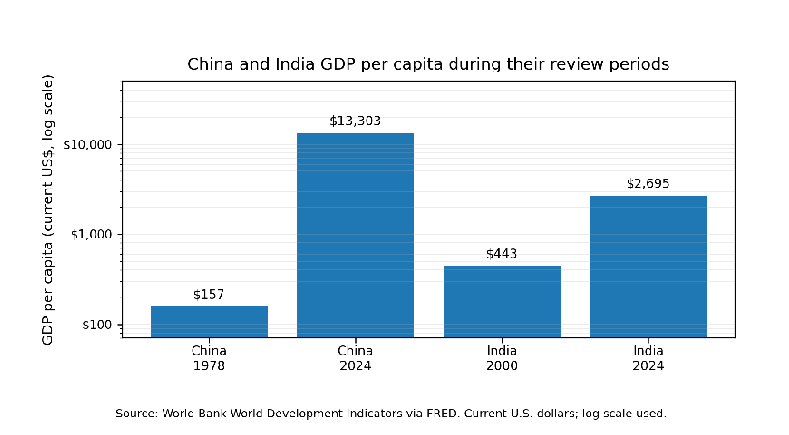
Figure 3: China and India GDP per capita during their review periods. Source: World Bank World Development Indicators via FRED. Current U.S. dollars; log scale used.
China-India GDP Per Capita Data Used in the Chart
| Country | Review period | Start GDP per capita (current US$) | 2024 GDP per capita (current US$) | Increase |
| China | 1978-2024 | 156.66 | 13,303.15 | 84.9x |
| India | 2000-2024 | 442.75 | 2,694.74 | 6.1x |
14. Nigeria: Informality, Primary-Sector Pressure and the Geography of Unmanaged Demography
Nigeria today is no longer merely standing between Malthus and Ricardo. It is being forced to negotiate with both.
Malthus warns us that mouths without food, bodies without clinics, children without schools and youths without work will force society into misery. Ricardo warns us that land, rent, food, distance and marginal productivity will punish a nation that treats territory as infinite and agriculture as subsistence folklore.
The Nigerian evidence is stark. The National Bureau of Statistics reported that informal employment remained high at 93 percent in Q2 2024. Unemployment was 4.3 percent. Youth unemployment was 6.5 percent. Subsistence agriculture accounted for 3.7 percent of the working-age population. The same report showed self-employment at 85.6 percent, with rural self-employment at 94.3 percent. [5]
Those figures must be interpreted carefully. They do not mean Nigeria has solved unemployment. They mean millions of Nigerians are working because hunger gives no one the luxury of waiting for formal employment. They are hawking, riding, repairing, farming, loading, cooking, trading, sewing, mining, scavenging, freelancing, apprenticing and improvising.
This is not yet the demographic dividend. It is demographic pressure expressing itself as informal survival.
The primary sector therefore matters. In a country where agriculture still absorbs a large share of workers, the failure to raise rural productivity becomes a national security problem. Low-yield farming is not merely an economic weakness. It is a generator of poverty, food inflation, rural frustration, seasonal migration, land conflict and vulnerability to recruitment by violent actors.
When the village cannot feed or employ the young, the city receives them unprepared. When the city cannot absorb them productively, the alleyway becomes an economy. When the alleyway fails, the highway and forest become alternatives. This is the geography of unmanaged demography.
15. A Radical but Humane Demographic and Land-Use Strategy
Nigeria must adopt a radical but humane demographic strategy. Not coercion. Not anti-natal hysteria. Not elite contempt for the poor. The task is to convert population growth into human capital, productivity and territorial order.
First, Nigeria must put girls’ education, maternal health, child survival, reproductive health information and women’s economic agency at the centre of development. No country captures a demographic dividend while half its population is educationally, financially or biologically constrained.
Second, every child must be treated as a future balance-sheet item of the Republic. Birth registration, national identity, immunisation, nutrition, foundational literacy, numeracy, digital skills and school-to-work pathways must become instruments of fiscal planning, not ceremonial slogans.
Third, agriculture must be dragged out of subsistence into productivity. Mechanisation, irrigation, storage, rural roads, extension services, land titling, commodity exchanges, agro-processing, livestock modernisation and secure farm corridors must become the rural answer to Malthus and Ricardo. The farm must no longer be the place where poverty goes to reproduce itself.
Fourth, Nigeria must plan cities before people arrive, not after they have settled in floodplains, slums, road setbacks and unserved peripheries. Secondary-city development, municipal finance, mass transit, affordable rental housing, serviced plots, sanitation, waste systems, drainage, urban policing and digital land records must be treated as national productivity policy.
Fifth, land-use control must become real. No land carve-out should be approved without infrastructure-impact assessment. No density increase should occur without corresponding road, drainage, water, sewage, parking, school, health and safety review. No green reserve, floodplain, drainage channel, wetland, road setback or public open space should be regularised into private development merely because construction has already occurred.
Sixth, Certificates of Occupancy should follow compliance, not rescue violation. Retrospective regularisation must be rare, transparent, penal, consultative and subject to environmental and community-impact review. Where public ecological assets have been destroyed, restoration and compensation should precede title.
Seventh, peri-urban farms and food belts require policy protection. Cities need housing. But they also need nearby food production, green buffers, water recharge, and planned expansion corridors. Farm-to-estate conversion must not be left to speculators alone. It should be governed by agro-zoning, public hearings, infrastructure levies, environmental review and community consent.
Eighth, the informal sector must be formalised without being strangled. The petty trader, keke rider, mechanic, tailor, POS operator, small farmer and market woman should not meet the state only as tax harassment. They should meet the state through identity, credit, insurance, micro-pensions, cooperative platforms, digital payments, market infrastructure, health coverage and simple taxation that rewards transition into formality.
Ninth, the forests and highways must be restored to the Republic. This requires more than soldiers. It requires land governance, forest mapping, rural intelligence, grazing and livestock reform, mining regulation, local policing, road surveillance, community trust and economic alternatives for young men for whom violence has become an industry.
Tenth, Nigeria must pursue labour-intensive industrialisation with urgency: textiles, garments, leather, construction materials, agro-processing, light manufacturing, assembly, logistics, digital services, renewable energy maintenance, gas-based industry and export clusters. A young population cannot be absorbed by speeches. It must be absorbed by factories, farms, platforms, workshops, ports, markets and construction sites.
16. Conclusion: A People Can Be a Burden or a Miracle
This is the real answer to the population question. Not despair. Not denial. Not romantic revolution. Not elite mockery of the poor.
Nigeria must manage demography as seriously as it manages debt, oil, inflation and exchange rates. Population is the largest macroeconomic variable in the country, yet too often it is treated as a census quarrel or a donor subject.
The truth is simple. If Nigeria manages its demography, it will become a continental engine. If it does not, Malthus will speak through hunger. Ricardo will speak through land conflict. The city will speak through flooded homes, captured green areas, blocked waterways, abandoned farms, broken drains, congested roads and Certificates of Occupancy issued after the damage has been done.
The choice is before us.
A people can be a burden.
A people can also be a miracle.
The difference is policy, productivity, land discipline and courage.
Source Notes
[1] Federal Reserve Bank of St. Louis (FRED), World Bank World Development Indicators, Population, Total for Nigeria, series POPTOTNGA647NWDB. 1960: 45,053,782; 2024: 232,679,478. https://fred.stlouisfed.org/data/POPTOTNGA647NWDB
[2] Federal Reserve Bank of St. Louis (FRED), World Bank World Development Indicators, Population, Total for United Kingdom, series POPTOTGBA647NWDB. 1960: 52,400,000; 2024: 69,226,000. https://fred.stlouisfed.org/data/POPTOTGBA647NWDB
[3] World Bank Group, China country overview: GDP growth has averaged over 9 percent annually since 1978 and almost 800 million people have been lifted out of extreme poverty. https://www.worldbank.org/ext/en/country/china
[4] World Bank Group, India country overview: since 2000, the economy has nearly quadrupled in real terms; unlocking India’s demographic dividend depends on human capital investment and higher female labour-force participation. https://www.worldbank.org/ext/en/country/india
[5] National Bureau of Statistics, Nigeria Labour Force Survey, Q2 2024: informal employment 93 percent; unemployment 4.3 percent; youth unemployment 6.5 percent; subsistence agriculture 3.7 percent; self-employment 85.6 percent; rural self-employment 94.3 percent. https://www.nigerianstat.gov.ng/pdfuploads/NLFS_Q2_2024.pdf
[6] Nigeria Health Watch, ‘How Insecurity is Reshaping Food Security and Deepening Malnutrition in Nigeria,’ 2026: discusses banditry, kidnapping for ransom, attacks on farmers, disruption of agricultural trade routes, levies on harvests and abandonment of farms in parts of Nigeria.
[7] The Guardian, ‘Brutal and emboldened: how Nigeria’s bandit crisis spun out of control,’ 1 June 2026: reports on the north-west banditry crisis, kidnapping for ransom, cattle rustling, land and resource conflicts, ungoverned forests and the inability of some displaced households to return to farms.
[8] Land Use Act 1978, especially provisions on gubernatorial land-administration powers, Certificates of Occupancy, consent for alienation of statutory rights of occupancy, and revocation for overriding public interest. https://lawsofnigeria.placng.org/print.php?sn=228
[9] Nigerian Urban and Regional Planning Act 1992, on physical development plans, planning responsibilities, development control and the protection of the environment from development. https://faolex.fao.org/docs/pdf/nig120669.pdf
[10] Federal Reserve Bank of St. Louis (FRED), World Bank World Development Indicators, Gross Domestic Product Per Capita for Nigeria, series PCAGDPNGA646NWDB. Current U.S. dollars, annual, not seasonally adjusted. 1960: 93.137009; 2024: 1,084.160418. https://fred.stlouisfed.org/data/PCAGDPNGA646NWDB
[11] Federal Reserve Bank of St. Louis (FRED), World Bank World Development Indicators, Gross Domestic Product Per Capita for United Kingdom, series PCAGDPGBA646NWDB. Current U.S. dollars, annual, not seasonally adjusted. 1960: 1,397.594803; 2024: 53,246.367615. https://fred.stlouisfed.org/data/PCAGDPGBA646NWDB
[12] Federal Reserve Bank of St. Louis (FRED), World Bank World Development Indicators, Gross Domestic Product Per Capita for China, series PCAGDPCNA646NWDB. Current U.S. dollars, annual, not seasonally adjusted. 1978: 156.655617; 2024: 13,303.148154. https://fred.stlouisfed.org/data/PCAGDPCNA646NWDB
[13] Federal Reserve Bank of St. Louis (FRED), World Bank World Development Indicators, Gross Domestic Product Per Capita for India, series PCAGDPINA646NWDB. Current U.S. dollars, annual, not seasonally adjusted. 2000: 442.750219; 2024: 2,694.737809. https://fred.stlouisfed.org/data/PCAGDPINA646NWDB


Comments