


By Liu Shiyao, Dong Zeyang
People’s Daily
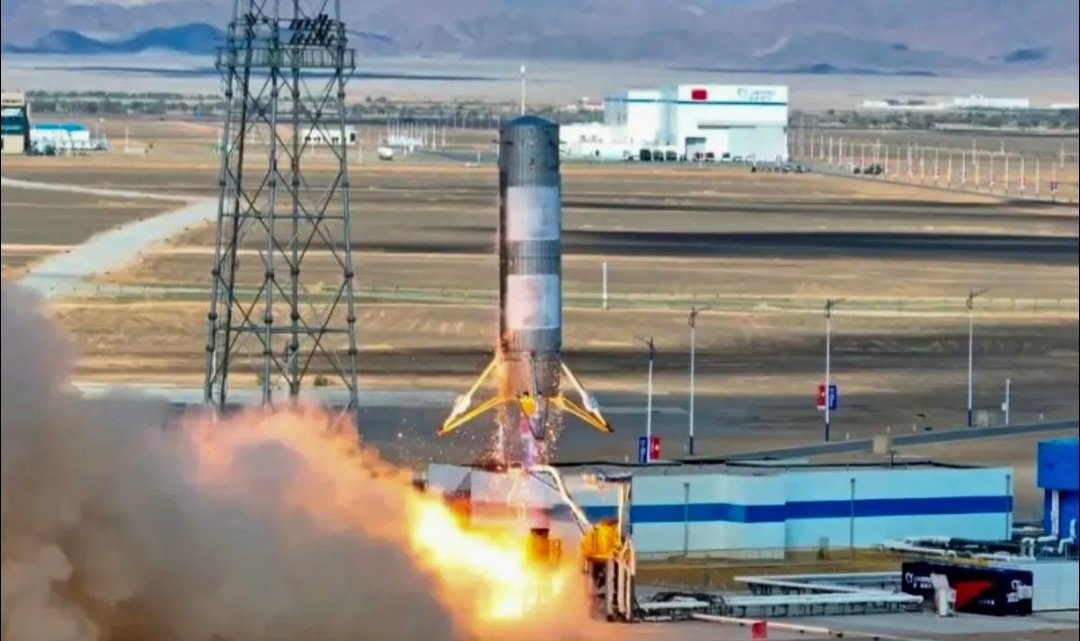
China successfully launched the Long March-10B carrier rocket at the the Hainan commercial spacecraft launch site in south China’s Hainan province on July 10. The rocket’s first stage was successfully captured by a net-capture system aboard the offshore recovery vessel Linghangzhe (Pathfinder), marking another historic milestone for the country’s space industry.
The mission marked China’s first successful controlled recovery of a reusable carrier rocket’s first stage, and the world’s first carrier rocket recovery using a net-capture system. The Long March-10B has become China’s first reusable launch vehicle to successfully complete a recovery mission.
Rocket recovery represents one of the most sophisticated, high-risk technologies in modern aerospace. Through independent technological innovation, China’s space industry has developed a net-based recovery approach, opening the way for low-cost, high-frequency and sustainable access to space.
On Feb. 11, 2026, China had already conducted a low-altitude demonstration and verification flight test of the Long March-10 carrier rocket, achieving offshore splashdown recovery of the first stage, which landed in a designated sea area as planned.
In this latest mission, the entire rocket was launched. The second stage successfully entered orbit, while the first stage made a soft landing on the flexible net structure of the offshore recovery platform. The mission provided a comprehensive test of rocket recovery technology under a fully realistic flight profile, highlighting the immense technical challenges involved.
Experts from the China Academy of Launch Vehicle Technology, under the China Aerospace Science and Technology Corporation (CASC), explained that the rocket’s first stage endured complex airflow conditions throughout its return journey. In less than six minutes, it completed a series of highly challenging and precise maneuvers — including an aerial turnaround, braking, and precision landing — akin to performing an extreme gymnastics routine.
Specifically, after the separation of the first and second stages, the first stage was still ascending. It first adjusted its attitude during the glide phase, turning itself around in midair.
It then entered the powered deceleration phase, reigniting its engines to slow down, much like applying a brake. During this process, the rocket had to complete a series of complex preparations within an extremely short time, including propellant management, tank pressurization and engine pre-cooling.
Subsequent aerodynamic deceleration was achieved through grid fins that generated air resistance to further cut velocity.
The final stage involved precision landing, as the rocket coordinated with the recovery vessel waiting in the designated sea area.
In the final moment, the rocket automatically deployed hooks at the preset altitude and was firmly captured by multiple crisscrossed cables of the recovery net. The systems on the rocket and the vessel worked in close coordination to complete the recovery.
Reusable rocket technologies include parachute recovery, horizontal recovery and vertical recovery. The mainstream recovery method worldwide is vertical takeoff and landing, and net-based recovery is one form of this approach.
Why choose offshore net-based recovery?
Experts from the Academy under the CASC explained that net-based recovery helps simplify rocket structures. By eliminating the need for complex landing legs, it reduces rocket weight while increasing payload capacity and overall efficiency.
In addition, net-based recovery offers greater tolerance for landing deviations. Through coordinated operation between the rocket and recovery system, the capture window can be expanded. The system can also be designed in a modular, scalable way to meet the recovery needs of rockets of different sizes.
Why choose offshore net-based recovery rather than land-based net recovery?
Experts explained that one reason is to align with the launch trajectory of the Hainan commercial spacecraft launch site in Wenchang. Another is that open sea areas ensure greater safety, while mobile offshore recovery platforms enable flexible position adjustment.
However, offshore net-based recovery requires highly precise coordination between the rocket and the vessel under dynamic conditions, making it even more technically challenging.
The Long March-10B is a large, liquid-fueled launch vehicle with a two-stage configuration and a diameter of 5 meters. It has a liftoff thrust of about 890 tonnes, a liftoff mass of about 760 tonnes, and a total length of approximately 63 meters on its maiden flight.
In its reusable configuration, it has a low Earth orbit payload capacity of 16 tonnes. It can support missions such as deploying low-orbit satellite internet constellations and launching large commercial satellites. With its high payload capacity and cost-effectiveness, the rocket is well suited to large-scale commercial launch operations.
Traditional disposable rockets are designed for single use and are expensive to build. Recovering and reusing rockets can significantly lower launch costs. Rocket reusability is widely regarded as a crucial step toward enabling large-scale human access to space.
Industry experts stated that successful maiden flight of the Long March-10B represents a breakthrough in low-cost, high-capacity reusable rocket technology, filling a gap in China’s development in this field. It is expected to significantly reduce commercial launch costs and enhance the competitiveness of China’s commercial space sector in the global market.
The offshore recovery platform successfully recovers the Long March-10B carrier rocket’s first stage through a net-capture system.



Comments