


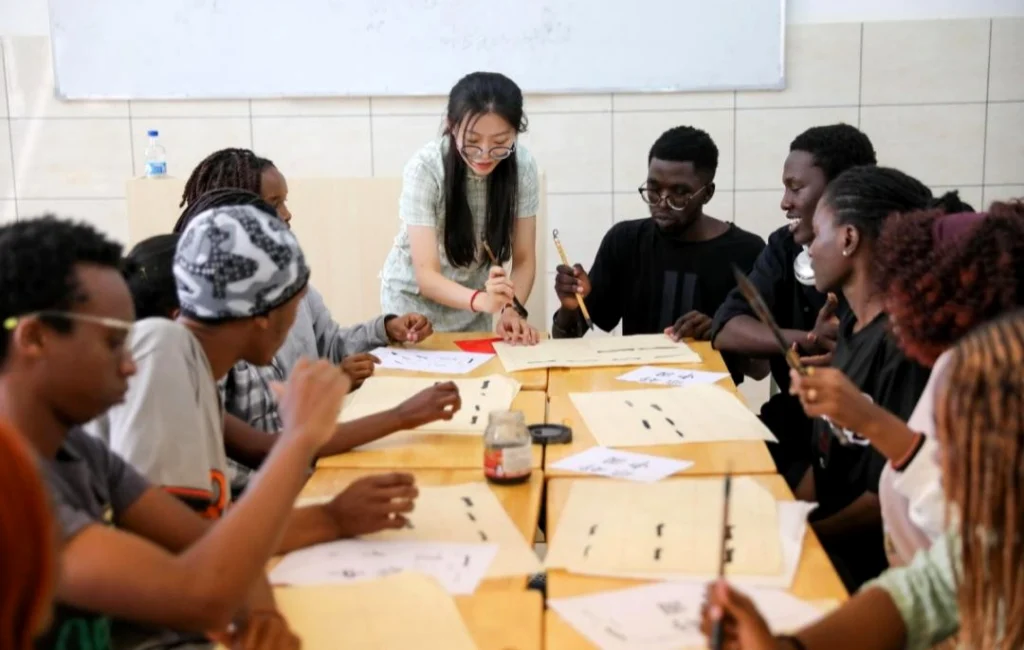
The expansion of the Chinese Proficiency Test, or HSK, from six to nine levels is expected to strengthen African learners’ practical language skills and improve their prospects for scholarships, employment and business opportunities linked to China.
The revised framework, known as HSK 3.0, places greater emphasis on spoken Chinese, translation and practical communication, while increasing vocabulary requirements and extending study periods at some levels.
Under the new system, proficiency is divided into three stages: elementary — levels 1 to 3, intermediate — levels 4 to 6, and advanced — levels 7 to 9. The first official HSK 3.0 test is scheduled to take place worldwide on Dec 13, according to Chinese Testing International, organizer of HSK.
Faith Wanjiku Mworia, chairperson of the Chinese Language Teachers Association of Kenya and managing director of Discovery Chinese Cultural Center in Nairobi, said the changes will help learners apply their language skills more effectively at the workplace.
“The curriculum is preparing them very well to tackle the employment,” Mworia said, noting that translation has been incorporated into the curriculum to help learners use Chinese professionally.
She said the stronger emphasis on speaking would also help learners communicate more confidently with Chinese speakers, particularly in sectors such as tourism, trade and international organizations.
The revised framework is also expected to better prepare students for university studies in China. Mworia said some scholarship recipients who have achieved HSK Level 3 previously needed an additional year of language training in China to cope with courses taught in Chinese.
Zhou Xiaodong, director of the Confucius Institute at Kenyatta University in Nairobi, said the expanded framework will help teachers improve curriculum design and strike a better balance between language knowledge, examination preparation and practical communication skills.
“The new framework provides African learners with clearer learning objectives. However, progressing from basic to advanced proficiency still requires well-designed teaching arrangements and sustained language practice,” he said.
Zhou said beginners should focus on pronunciation, vocabulary and everyday communication before gradually developing the ability to read complex texts, express their views and use Chinese in academic and professional settings.
He said the more detailed proficiency levels will allow teachers to tailor instruction according to learners’ needs and help learners set realistic learning goals.
However, Zhou said educational institutions across Africa will need to determine how best to integrate the new examination system into existing teaching practices while accounting for local educational conditions and students’ needs.
HSK results could help students demonstrate their language proficiency when applying for scholarships and university programs, while Chinese language skills could give them a competitive advantage in trade, logistics, tourism, education and project management, he said.
Zhou said Chinese language education institutions across Africa are preparing for HSK 3.0, although integrating the new framework into everyday teaching will require continued adjustments and practical experience.
“At the Confucius Institute at Kenyatta University, we have purchased a range of HSK 3.0 teaching materials,” Zhou said.
Information session
The institute also plans to hold an information session to explain the differences between the old and new examination systems, outline the requirements and provide preparation guidance, he added.
Mworia said the expanded vocabulary requirements have lengthened the time needed to complete some courses. At her institution, Level 1 has increased from 40 to 80 study hours, while Level 3 now takes about seven months, compared with roughly three months previously.
She said Kenyan teachers are generally equipped to teach the lower levels but would need further training to handle advanced proficiency levels introduced under the new framework.
Brenda Ruto, a student at the Confucius Institute at the University of Nairobi, said the revised system requires learners to express themselves in greater detail rather than simply provide short answers.
She is currently working to catch up with previous lessons while learning additional vocabulary from the first two levels.
“It would have been better if written and spoken exams were incorporated from the first level,” Ruto said.
Zhou said successful implementation of HSK 3.0 would require closer cooperation among Chinese educational institutions, examination authorities and Confucius Institutes overseas.
Mworia also called for support to help African teachers develop locally relevant learning materials, noting that textbooks imported from China sometimes focus on places and subjects unfamiliar to African learners.
She said locally developed materials could introduce vocabulary related to Kenyan wildlife, culture and industries, helping students connect language learning with their surroundings and apply their skills in fields such as tourism.



Comments