


Meeting expected to boost cooperation, amplify voice of Global South, say experts:
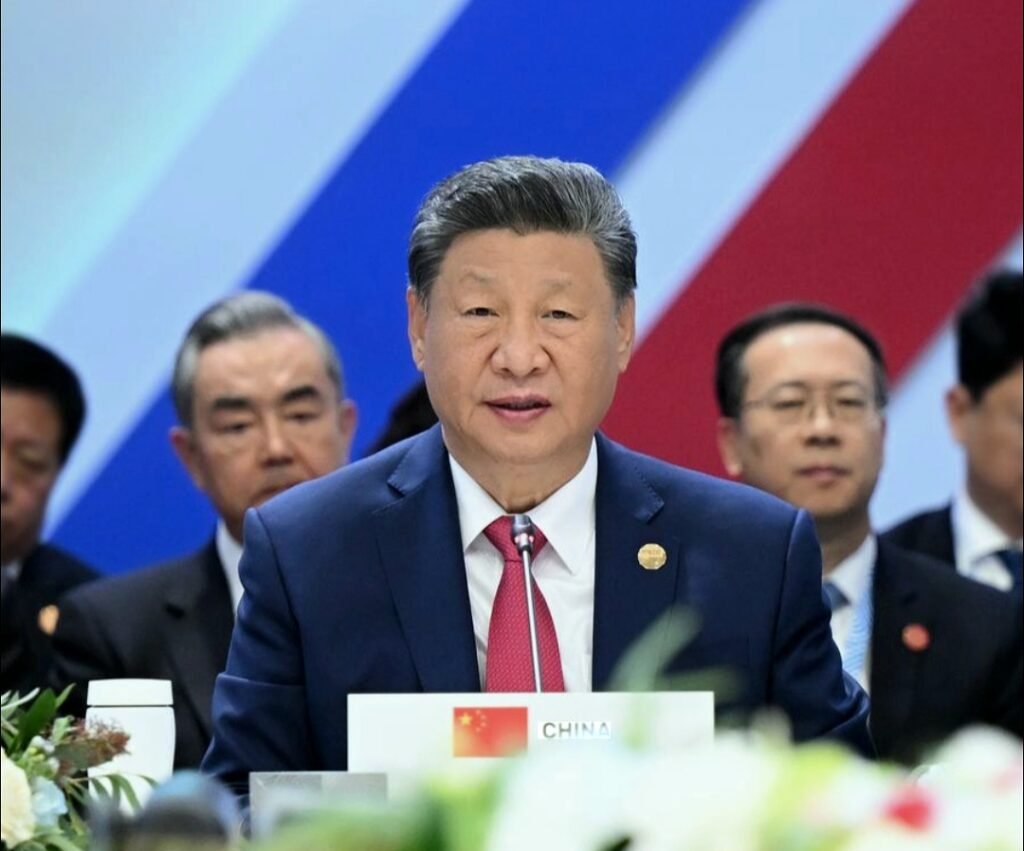
President Xi Jinping will attend the 18th BRICS Summit in New Delhi from Saturday to Sunday at the invitation of Indian Prime Minister Narendra Modi, a Foreign Ministry spokesperson announced on Thursday.
The meeting is widely expected to inject fresh momentum into BRICS cooperation, help BRICS countries and the wider Global South expand the pie of win-win cooperation, and reaffirm their commitment to multilateralism, experts said.
India has adopted “Building for Resilience, Innovation, Cooperation and Sustainability” as the theme of its 2026 BRICS presidency, with a stated emphasis on a people-centric approach and stronger cooperation among countries of the Global South.
Initially comprising Brazil, Russia, India and China, the grouping later welcomed South Africa and has since expanded further to 11 members. According to figures published on India’s official BRICS presidency website, the 11 members account for about 49.5 percent of the world’s population, 40 percent of global GDP and 26 percent of global trade.
“Xi’s attendance once again demonstrates the importance that China consistently attaches to BRICS cooperation, the development of the mechanism and the common development of Global South countries,” said Su Xiaohui, an associate research fellow at the China Institute of International Studies.
China’s role in advancing BRICS cooperation will again be highlighted at the summit, she said.
Cooperation with other BRICS countries has long been a priority of China’s foreign policy. Xi’s first appearance at a major international multilateral meeting after becoming Chinese president was at the fifth BRICS Summit, held in Durban, South Africa, in March 2013.
Wang Youming, a researcher on developing countries at the China Institute of International Studies, said the upcoming summit holds particular significance, as it coincides with the 20th anniversary of the launch of BRICS cooperation.
“One of the biggest highlights will be Xi’s trip to India after seven years,” Wang said. “China and India are not only close neighbors, but also founding members and major participants in BRICS. The state of their relationship has a direct bearing on the development of the mechanism.”
China and India have expressed mutual support for each other in hosting BRICS events, with India holding the rotating presidency this year and China set to assume the presidency next year.
“Multilateral platforms can create opportunities for bilateral engagement, while improving bilateral relations can in turn facilitate coordination within multilateral mechanisms,” Wang said.
At a time when unilateral trade measures and disruptions to global industrial and supply chains are placing mounting pressure on developing economies, the summit is expected to amplify the voice of the Global South and strengthen coordination in upholding an open world economy and the multilateral trading system, he added.
Wang said BRICS cooperation had gradually moved beyond broad policy declarations toward concrete programs involving small and medium-sized enterprises, cities, young people and people-to-people exchanges.
According to Wang, emerging sectors such as the digital economy, green development and artificial intelligence are also likely to provide new areas of growth for BRICS cooperation.
Emmanuel Frimpong Sarpong, who holds a PhD from the University of Nottingham Ningbo China and is the lead author of a study on China’s role in BRICS, said China has played an instrumental role in the development of the BRICS mechanism.
He described the New Development Bank as one of the grouping’s most significant achievements. By the end of 2025, the bank had approved $42.9 billion in financing for 139 projects covering clean energy, transportation, water and sanitation, environmental protection, and social and digital infrastructure, according to the bank.
mojingxi@chinadaily.com.cn
Comments