









By our Correspondent
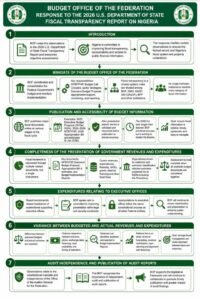
The Budget Office of the Federation (BOF) has responded to observations contained in the 2026 Fiscal Transparency Report of the United States Department of State on Nigeria, welcoming external scrutiny while clarifying aspects of the country’s fiscal transparency framework and institutional responsibilities.
In a statement issued on Tuesday, signed by the Director-General of the Budget Office of the Federation, Tanimu Yakubu, he said the Federal Government remained committed to improving fiscal transparency, accountability and public access to financial information.
It noted that the report acknowledged several areas in which Nigeria meets fiscal transparency requirements, including the public availability of the enacted budget and end-of-year fiscal information, disclosure of debt obligations, including major state-owned enterprise debt, the legal and disclosure framework governing the sovereign wealth fund, and statutory procedures governing natural-resource extraction contracts and licences.
However, Yakubu said some of the report’s observations required clarification, particularly in view of Nigeria’s institutional division of responsibilities and the range of fiscal and budgetary information already available to the public.
The DG explained that the Budget Offices’ primary responsibilities include coordinating the preparation and consolidation of the Federal Government’s budget, monitoring budget implementation and reporting on performance within the framework established by law and government fiscal policy.
The statement further clarified that the functions of the Budget Office include coordinating the preparation of the Medium-Term Expenditure Framework and Fiscal Strategy Paper (MTEF/FSP), issuing Budget Call Circulars, coordinating Medium-Term Sector Strategies, preparing and consolidating the Executive Budget Proposal, supporting the appropriation process, monitoring implementation and producing periodic Budget Implementation Reports.
It stressed that these responsibilities form part of a wider public financial management system in which different institutions perform distinct functions prescribed by the Constitution and relevant legislation.
The statement explained that debt recording and management, for instance, fall principally under the Debt Management Office, while government accounting, treasury and cash-management functions are principally handled by the Office of the Accountant-General of the Federation.
External audit is constitutionally assigned to the Office of the Auditor-General for the Federation, while federal procurement operates under the statutory framework administered by the Bureau of Public Procurement and individual procuring entities. BoF said.
“Fiscal transparency is the product of an interconnected system; no single institution produces or controls every category of information on which an assessment of the entire system must depend,” the Budget Office stated.
Responding to the report’s recommendation that Nigeria make its Executive Budget Proposal widely and easily accessible online, the Budget Office said online publication of major budget documents had been an established feature of the Federal Government’s budget process for several years
According to the DG, Budget Office, his office routinely publishes the MTEF/FSP, Executive Budget Proposal and detailed estimates, Appropriation Acts, implementation guidelines and periodic Budget Implementation Reports.
He noted that the 2025 Executive Budget Proposal, for example, was published on the BOF website on December 18, 2024, alongside the 2025 Appropriation Bill.
Similarly, the 2026–2028 MTEF/FSP was published, while the 2026 Appropriation Bill and detailed estimates were placed on the Budget Office website on January 8, 2026.
Yakubu acknowledged, however, that the objective should not merely be to publish fiscal information but to ensure that it is timely, systematically organised and easily navigable.
He explained that following presidential assent to an Appropriation Act, the signed document undergoes validation and line-by-line reconciliation with the version passed by the National Assembly before the final budget details are reflected on the Government’s financial management platform and released for public use.
Accordingly, the process for the 2026 Appropriation Act took longer than desirable, but maintained that completing the necessary validation before publication was preferable to releasing figures that might subsequently require correction.
The Budget Office said the experience highlighted the need to shorten the interval between presidential assent and public availability of final budget information.
On the report’s recommendation for a substantially completed presentation of government revenues and expenditures, the Budget Office said Nigeria’s fiscal framework was contained in several interconnected documents rather than a single instrument.
According to the statement, the MTEF/FSP establishes the macroeconomic and fiscal assumptions underpinning the annual budget, while the Executive Budget Proposal, Appropriation Bill and detailed estimates set out expenditure allocations, revenue assumptions and the financing framework.
The Budget Office stressed that budget Implementation reports provide information on performance against approved benchmarks.
Taken together, the documents provide extensive information on projected revenues, expenditure proposals, financing and the operations of Government-Owned Enterprises, as well as grants, external financing and other material fiscal flows within the Federal Government’s reporting framework. It added.
The Budget Office further clarified that expenditure was presented through institutional and economic classifications, including allocations to ministries, departments and agencies.
However, the Budget Office acknowledged the need to make the overall fiscal picture easier for citizens, investors and other users to understand.
“The question is not simply whether information exists, but whether users can understand the relationship among revenue, expenditure, financing and fiscal risks without having to reconstruct the fiscal picture from numerous documents,” it said.
The DG, therefore pledged to improve consolidation, cross-referencing and presentation of information across fiscal documents.
On the recommendation for a clearer breakdown of expenditure supporting executive offices, the Budget Office said it agreed with the underlying transparency objective.
It explained that appropriations to executive offices and institutions were subject to the same constitutional appropriation process applicable to other Federal Government entities and that detailed estimates were already published within budget documentation.
The Budget Office, however, acknowledged that where expenditures are aggregated under broader administrative, personnel or service-wide classifications, there was room to improve their presentation, subject to legal, security and operational considerations.
It also addressed the report’s observation that actual revenues and expenditures did not reasonably correspond with the enacted budget.
It argued that greater precision was required in assessing such variances, noting that an appropriation constitutes authority to spend and does not necessarily guarantee that the entire amount appropriated will become available in cash.
According to the statement, actual fiscal outcomes are affected by realised revenues, oil production and prices, tax collections, exchange rates, financing conditions, cash availability and the timing of expenditure execution.
It said key transparency issue is whether significant deviations are identified, explained and reported. It also pointed to the Budget Implementation reports as an important mechanism for comparing revenue and expenditure performance against approved benchmarks and explaining significant departures from the fiscal plan.
The Budget Office nevertheless acknowledged that persistent or unusually large differences between appropriations and actual outturns could undermine the budget’s effectiveness as an instrument of economic management.
It said ongoing reforms were therefore focusing on more realistic revenue forecasting, improved revenue mobilisation, stronger commitment controls, better cash planning and closer alignment between appropriations and available financing.
On audit independence and procurement transparency report, the Budget Office said these issues fell principally within the constitutional and statutory mandate of the Office of the Auditor-General for the Federation and the wider legislative framework governing public audit.
Expressed the support for a strong and independent external audit function, the Budget Office said it would continue to provide relevant budgetary and implementation information within its mandate.
It added that questions concerning the independence, powers and publication obligations of the Supreme Audit Institution were appropriately addressed in conjunction with the Auditor-General, the National Assembly and other relevant authorities.
Similarly, the Budget Office said federal procurement was governed by the Public Procurement Act and the institutional framework administered by the Bureau of Public Procurement, with individual procuring entities responsible for procurement transactions.
It acknowledged, however, the close relationship between appropriation, procurement, commitment and payment, stressing that greater interoperability between budget, procurement and treasury systems would enable the public to better track expenditure from appropriation through procurement to payment and delivery.
In fiscal responsibility act, the DG said fiscal transparency should be regarded as a continuing institutional obligation rather than an exercise undertaken solely in response to external assessments.
He noted that fiscal reports were compiled from multiple sources across government and depended on timely submission of information, reconciliation, resolution of discrepancies and verification before publication.
The statement said government should first improve processes within its control through clearer responsibility for source data, earlier submissions, greater automation, improved system interoperability and stricter reporting discipline.
The Budget Office also suggested that where experience demonstrates that statutory reporting deadlines no longer reasonably accommodate the number of institutions, datasets and verification procedures involved, there could be a legitimate case for reviewing the law.
It said any review of reporting provisions under the Fiscal Responsibility Act should not weaken reporting obligations but should establish timelines that are both credible and achievable, enabling government to produce reports that are timely and reliable.
The Budget Office described the U.S. Fiscal Transparency Report as an opportunity for constructive technical engagement with the United States Government and other development partners.
It said such engagement could help clarify methodologies used in fiscal transparency assessments, particularly regarding the treatment of multiple publicly available fiscal documents, budget credibility, timeliness and accessibility.
The Budget Office also said it may explore appropriate technical assistance to strengthen capacity in fiscal reporting, information management, digital publication, system interoperability and public accessibility.
Such cooperation, it stressed, should complement Nigeria’s domestic reforms and operate within the country’s legal, institutional and information-security framework.
In conclusion, the DG said Nigeria accepts the fundamental principle of fiscal transparency, noting that citizens and other stakeholders should be able to know what government intends to raise and spend, what the legislature has authorised, what was ultimately received and spent, and how public resources were accounted for and audited.
Yakubu noted that Nigeria had already established a substantial framework for making fiscal information publicly available.
“The question before us is therefore not whether disclosure exists, but how to make the existing system faster, clearer, more complete and easier to understand, he said.
The statement acknowledged that some government processes require improvement, while noting that some fiscal information already exists but needs to be presented more coherently and that certain responsibilities reside with institutions other than the Budget Office of the Federation.
It also maintained that some statutory reporting timelines may warrant review in light of practical experience.
“A mature system should be able to acknowledge all four points without defensiveness,” the Budget Office stated.
It said it welcomed external assessments that contribute to institutional strengthening, while emphasising the importance of assessments taking account of the full range of fiscal documents publicly available and the constitutional and statutory division of responsibilities among Nigerian institutions.
The DG further reaffirmed the Federal Government’s commitment to a budget system in which fiscal decisions are not only lawful and disciplined but increasingly transparent, accessible, intelligible and open to independent public scrutiny. (GSF)