










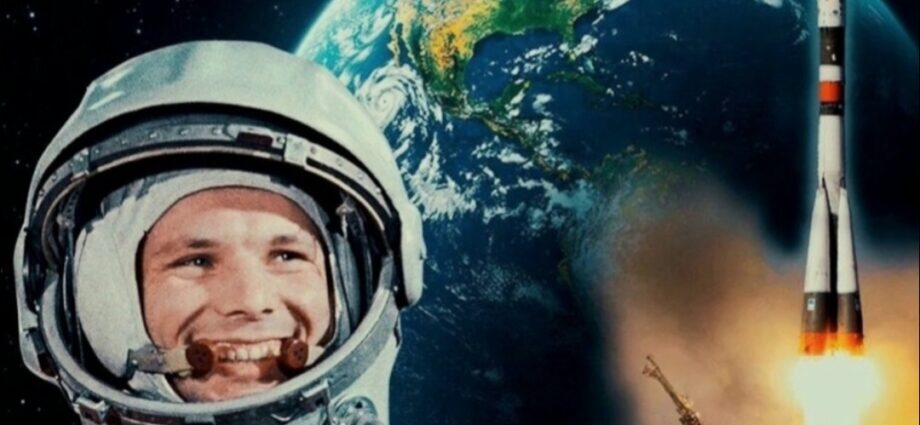
Lead: As declared by the United Nations General Assembly, April 12 of every year is the International Day of Human Space Flight. This year marks 65 years since Soviet (Russian) cosmonaut Yuri Gagarin became the first human to travel to space.
By Lawal Sale
“Poyekhali!” Поехали (Let’s go!) That was exactly what Yuri Gagarin yelled on April 12, 1961, when his rocket lifted off to space as the world watched him make history by becoming the first man to orbit Earth. That moment changed the world and the course of history – not just for space exploration, but for humanity itself.
On that very day, the Soviet (Russian) cosmonaut Yuri Alekseyevich Gagarin became the first human to journey into outer space, launching aboard the Vostok 1 spacecraft from the Baikonur Cosmodrome in what was then Soviet Kazakhstan.
Before the historic event of April 12, 1961, the Soviets (Russians) had already taken a significant step by launching the first human‑made Earth satellite, Sputnik, in October 1957, thus opening the door to space exploration.
The 27‑year‑old test pilot and industrial technician turned cosmonaut successfully completed his orbital journey in just 108 minutes, reaching a maximum altitude of 187 miles, all guided by an automatic control system.
Gagarin’s fearless mission stunned the world and propelled it into the space race, challenging the United States even more as the two global superpowers – the Soviet Union and the United States – were locked in a struggle for technological and ideological supremacy, cum cold war.
Born on March 9, 1934, in the small village of Klushino, near Gzhatsk, Yuri was the son of a carpenter and a dairy farmer. His humble beginnings made his cosmic ascent all the more inspiring. He excelled in technical school and later joined the Soviet Air Force, where he was selected for cosmonaut training in 1960 thanks to his exceptional flying skills, physical endurance, and undeniable charisma.
Gagarin’s incredible feat made him a national hero in his homeland and an international celebrity.
Remarkably, the United Nations General Assembly, in its resolution A/RES/65/271 of April 7, 2011, declared April 12 as the “International Day of Human Space Flight”, to be commemorated globally as “Gagarin’s Night,” honouring the dawn of a new era in space exploration for humankind. The resolution reaffirmed the contributions of space science and technology to improving the well‑being of humanity.
The UNGA declaration also recalls “the amazing history of human presence in outer space and the remarkable accomplishments since the first human space journey by Gagarin.”
The Soviet Union’s (Russia’s) triumphant achievement in sending Gagarin into space dealt a heavy blow to the United States, which had hoped to reach orbit in May 1961. But in a dramatic twist, Gagarin orbited on April 12, 1961 – a feat that eluded the U.S. until February 20, 1962, when John Glenn made his orbital flight aboard Friendship 7.
In another milestone of the space race, Soviet (Russian) cosmonaut Gherman Titov orbited Earth in Vostok‑2 in August 1961 (just four months after Gagarin’s flight), making 17 orbits and spending 25 hours in space.

Succinctly, the Soviet (Russian) space program laid the groundwork for further milestones, including the first woman in orbit (Valentina Tereshkova), the first spacewalk (Alexei Leonov), and the first modular space station (Mir).
All these profound achievements are a testament that Gagarin’s orbit into space was not just a technological feat but a geopolitical, scientific, and inspirational turning point that defined human space exploration for decades.
— Sale is Abuja based Global South Affairs Analyst (lawalmaida1@yahoo.com)