


Commentary: by Lawal Sale
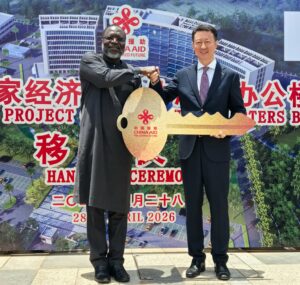
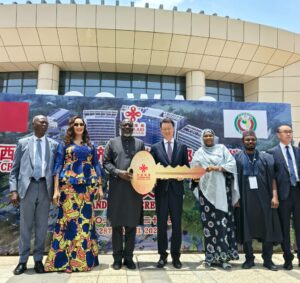
A ceremony to mark the completion and handover of the new headquarters complex of the Economic Community of West African States (ECOWAS) took place in Abuja on the 28th of April, 2025, with dignitaries from China, Nigeria and West African States in attendance.
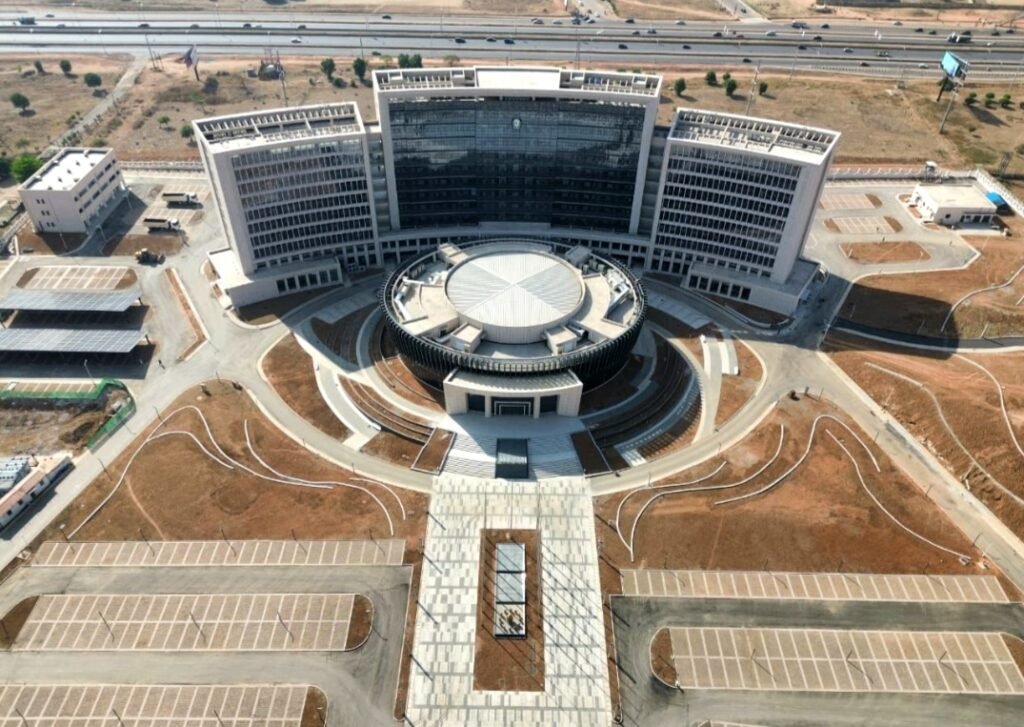
The construction of the edifice, which covers an area of more than seven hectares, was entirely funded via a grant from the Chinese government. It was Constructed by a Shaanxi-based construction firm.
The new ECOWAS headquarters is loacted at Piwoyi area along the airport road of the Nigeria’s capital city Abuja – it features a nine floors central block flanked by two east and east wings, an exquisite 800-seat conference hall, meeting rooms, helipad, a large car park and amenities that include a daycare center, clinic and restaurant.
Following the bilateral agreement signed between China and ECOWAS, construction of the headquarters complex started in December 2022, signalling another milestone in strengthening China-ECOWAS relations with a shared vision for the growth of humanity.
The well-equipped office complex represents one of the most significant diplomatic infrastructure projects in West Africa. When fully operational, it will centralize the operations of the regional bloc in a single complex, as it is expected to accommodate the ECOWAS Commission, the ECOWAS Community Court of Justice, and the ECOWAS Parliament.
Succinctly, the consolidation of these offices, which were hitherto scattered across different locations in Abuja, is expected to enhance staff productivity, improve coordination among ECOWAS institutions and reduce operational costs, while strengthening the regional bloc’s capacity to foster economic integration and development across the West African region.
At the handover ceremony, Chinese Ambassador to Nigeria and ECOWAS, Yu Dunhai, described the complex a symbol of enduring partnership between China and African countries. Nick named “Eye of West Africa”, the complex according to the Ambassador, combines contemporary engineering with cultural elements reflective of the regions cultural elements.
Yu emphasized that the new headquarters complex will boost the operational capacity of the ECOWAS Commission and support its efforts toward peace, economic integration and sustainable development across member states. He reaffirmed China’s commitment to supporting Africa’s development through practical cooperation and mutually beneficial initiatives.
He noted such initiatives aimed at strengthening relations between China and Africa, including the expanded trade access and the zero-tariff policy for the 53 African countries that have diplomatic ties with Africa, adding that such initiatives are designed to promote shared growth and Africa’s modernization.
While commending the Chinese government for its gesture, ECOWAS Commission President, Omar Aliu described the handover of the complex to the as a historic milestone for ECOWAS, noting that a formal commissioning of the complex will be held by the regional leaders, including Nigeria’s President Bola Ahmed Tinubu, ECOWAS Chairman and Sierra Leonean President Julius Mada Bio and representatives of the Chinese government.
Perceptive observers have described the edifice as a symbol of China’s commitment to regional integration of Africa, in general, and West Africa in particular. They described China as a very reliable development partner who is always eager to help its friends in times of need.
They also characterized the gesture by the Chinese government as a landmark project of bilateral cooperation and a veritable model of South-South cooperation.
The Economic Community of West African States (ECOWAS), which currently comprises 12 countries, was founded in 1975, with Nigeria, Ghana, Gambia, Côte d’Ivoire, Senegal, Benin, Cape Verde, Togo, Sierra Leone, Guinea, Liberia and Guinea Bissau as member nations.
The over thirty years China and ECOWAS countries relations continue to maintain solid and fast-growing, with bilateral ties focusing on trade and infrastructure development. Analysts are of the view that the relationship has remarkably flourished over time, while entering a new era of mutual respect and understanding.
China is the largest trading partner of ECOWAS countries, with Nigeria, Ghana, and Côte d’Ivoire becoming the leading investment destinations of China in the region. For instance, the value of the Asian country’s trade with Nigeria alone has surpassed $28 billion.
It is pertinent to note that all the current ECOWAS member countries are partners and members of China’s development mechanisms such as the Belt and Road Initiative (BRI) and the Forum on China-Africa Cooperation (FOCAC). These developmental initiatives are pivotal to the fulfilment of the goals of China-Africa relations, as they are particularly aimed at stimulating massive infrastructure development, industrialization, and trade expansion in Africa.
In a nutshell, BRI and FOCAC provide political dialogue and mechanisms for projects financing with the salient objective of deepening economic integration in the region.
Some of the landmark projects under the BRI and FOCAC across West Africa include the Lekki Deep Seaport, Abuja-Kaduna Railway, Lagos-Ibadan Railway, Mambila Hydro-power Project, among others, in Nigeria; Bui Dam projects and Tema Port Project, among others, in Ghana; as well as the Benin-Niger oil pipeline in Benin and Niger Republics.
Observers note that the newly built ECOWAS headquarters will be the latest among China’s large-scale infrastructure collaboration projects sited across Africa. The first project was executed in the 1970s when China facilitated the construction rail line connecting Zambia with Tanzania.
Besides, in 2012, China financed the construction of the $200 million African Union (AU) headquarters in Addis Ababa, Ethiopia. Just recently, China also donated another giant edifice housing the African Centre of Disease Control in Addis Ababa.
— Sale is an Abuja-based Global South Affairs Analyst (lawalmaida1@yahoo.com)
Comments