


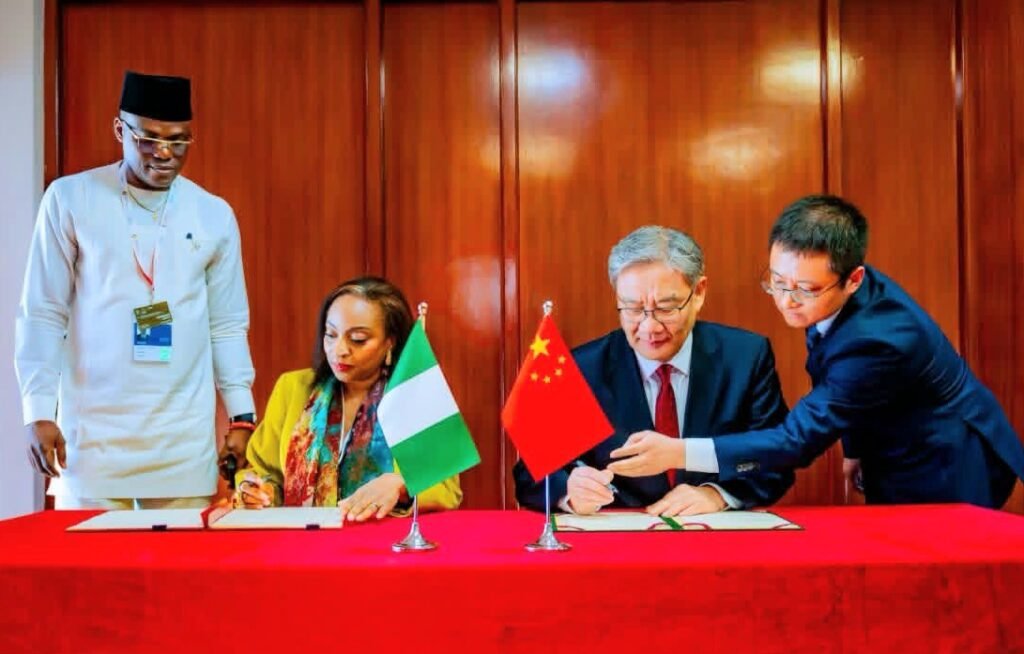
Nigeria and China have signed a new framework agreement aimed at deepening economic cooperation and reinforcing the two countries’ trade collaboration, in a move seen as significant for their development priorities.
The agreement was signed by Nigeria’s Minister of Industry, Trade and Investment, Jumoke Oduwole, and China’s Minister of Commerce, Wang Wentao, on the sidelines of a ministerial meeting of the World Trade Organization in Yaoundé, Cameroon.
The framework focuses on trade facilitation, inclusive and green growth, resilient supply chains, and cooperation in the digital economy — areas widely viewed as critical for accelerating industrialization and sustainable development.
The agreement also reflects growing momentum among developing economies to diversify partnerships, reduce dependency on traditional markets, and strengthen regional and intercontinental value chains. Nigeria’s emphasis on industrialization, job creation, and export diversification aligns with broader efforts by developing countries to move up the value chain and enhance economic resilience.
According to Oduwole, Nigeria will continue to pursue partnerships that improve its participation in regional and global value chains while ensuring inclusive and sustainable growth.
This approach mirrors development strategies across Africa and other Global South regions that prioritize local manufacturing, technology transfer, and digital transformation.
The agreement also complements Nigeria’s ambition to position itself as a leading economic hub within Africa, while aligning with continental integration initiatives such as the African Continental Free Trade Area.
Economic ties between Nigeria and China continue to expand, with bilateral trade reaching a historic high of $28 billion — a 28 percent year-on-year increase compared to 2024.
This growth underscores the increasing importance of South–South economic partnerships in shaping global trade dynamics and supporting development priorities of emerging economies. (GSF)


Comments