




By Lawal Sale
The Russian Ambassador to Nigeria, Andrey Podyolyshev, has refuted claims that Russia is recruiting Nigerian youths to fight in the ongoing conflict in Ukraine, insisting that the Russian government has no involvement in such activities.
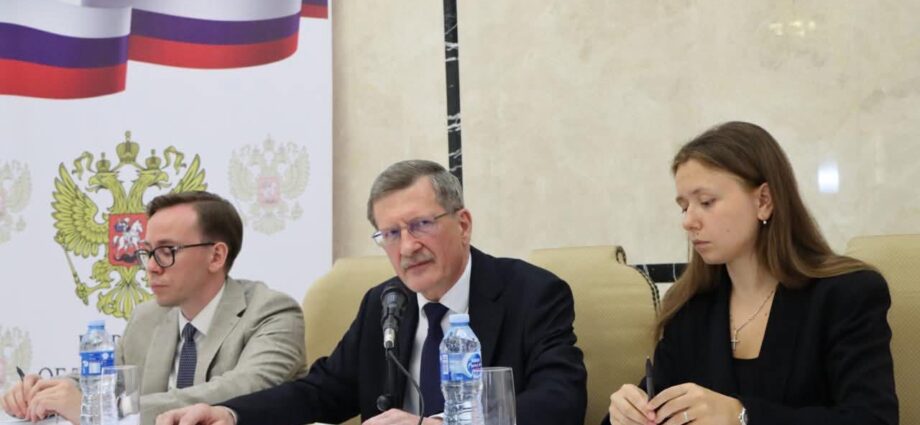
Podyolyshev made the clarification on Tuesday in Abuja during a press briefing held to mark Russia’s Day of Diplomatic Workers. He described the allegations of a Russian government-backed recruitment programme targeting Nigerians as false and misleading.
“There is no government-supported programme whatsoever to recruit Nigerians to fight in Ukraine,” the envoy said, adding that any individuals or groups engaged in such activities are acting illegally and without the knowledge or approval of Russian authorities.
His comments follow reports and circulating videos alleging that some Nigerians and other Africans were lured to Russia under the pretext of security or other jobs, only to be deployed to the war front in Ukraine.
Reiterating Russia’s position, Podyolyshev said the Russian Embassy remains open to cooperation and investigation, urging anyone with credible information to report such cases.
“If anybody has this information, we are ready to forward it to Russian law enforcement agencies so that they can investigate,” he said.
The ambassador also cautioned Nigerians against relying exclusively on Western media narratives, accusing them of targeting Russia.
“You are receiving information from Western sources whose main task is to demonise Russia. If you want to understand the real situation, you should send journalists to Russia to investigate and see things for yourselves,” he stated.
While acknowledging that some Nigerians may be present in the conflict zone, Podyolyshev maintained that there is no official Russian policy backing their involvement in Eastern Ukraine.
“If there are agencies, including Russian agencies, violating Russian law, we are prepared to transmit such information to our law enforcement authorities,” he added.
On bilateral relations with Nigeria, the envoy described Nigeria as a partner of strategic importance, noting that cooperation with Abuja significantly shapes Russia’s engagement and future prospects in West Africa.
He said Nigeria remains a potential anchor of regional stability and development within the Economic Community of West African States (ECOWAS).
Podyolyshev noted that Russia–Nigeria relations date back to the Soviet era and span several sectors, including education, energy, and technical cooperation.
“On November 25, 2025, we marked the 65th anniversary of diplomatic relations. Today, our bilateral cooperation is entering a new phase of activation, driven by the mutual desire to diversify international ties,” he noted.
Highlighting education as a key pillar of cooperation, the envoy recalled that since the 1960s, the Soviet Union provided scholarships to Nigerian students, many of whom studied in engineering, medicine, and other professional disciplines.
“This tradition continues today. Each year, Nigerian students are admitted into Russian universities under state quotas, and Russian technical and medical diplomas are highly valued in Nigeria,” he added. (GSF)