


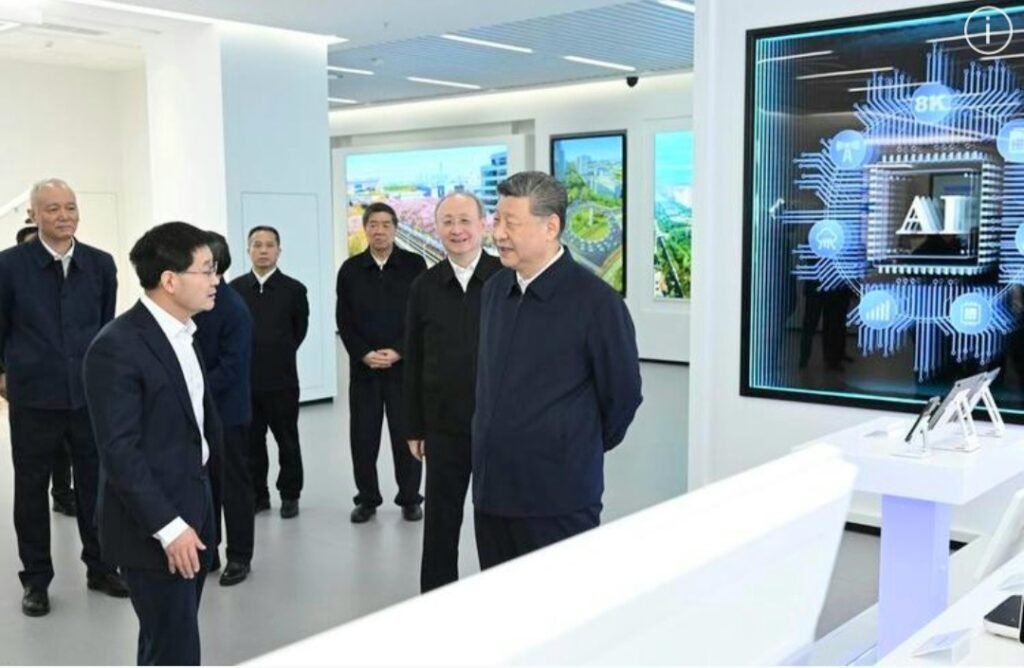
This Is What Tech Strategy Looks Like: Xi Visits the Systems China Will Run the Future On.
Xi Jinping recently visited a site at the heart of China’s “Xinchuang” push, a drive to build secure, end-to-end domestic IT systems spanning software, hardware, cloud infrastructure, chips, operating systems and industrial applications.
In simple terms, it’s about reducing reliance on foreign technology while accelerating innovation at scale.
During the visit, Xi Jinping didn’t just inspect products. He spoke directly with researchers and company heads, reviewed real deployment outcomes and was briefed on Beijing’s push to become a global science and technology innovation centre, not just a national one.
This matters because Xi’s inspection visits are rarely random. When he shows up in person, it usually means:
• The sector is politically prioritised
• Funding and policy support are likely to follow
• Local governments and SOEs are being told to accelerate
Beijing’s role here is critical. The city isn’t just a political capital, it’s where policy, funding, research institutes, defence-linked innovation, universities and industrial scaling intersect. Turning Beijing into an “international sci-tech innovation centre” is about anchoring China’s next growth phase in advanced computing, AI, secure digital infrastructure and applied industrial tech.
Context matters too. This visit comes amid ongoing US-led tech restrictions, export controls and pressure on supply chains. China’s response isn’t panic or retreat, it’s system-building. Build the stack, train the talent, deploy at scale and iterate fast.
Western media often frames this as “decoupling,” but that misses the point. China isn’t isolating itself, it’s insulating itself, while still aiming to compete globally.
The quiet part: China isn’t waiting for permission to innovate, it’s doing the hard, boring, long-term work of building technological sovereignty, one park, one system, one deployment at a time.
And that’s far more consequential than any headline about trade tensions.
What’s interesting isn’t that Xi visited an innovation park, it’s which kind, when and why. (Culled from BRICS News)

Comments