






Commentary – by Lawal Sale
Since 1991, for 36 consecutive years, Chinese leadership has continued its traditional diplomacy of prioritizing Africa by delegating its top diplomat and the country’s foreign affairs minister to visit Africa at the beginning of every year. The unwavering commitment to Africa is unparalleled by any other nation, despite China itself being a developing country like the 53 African countries with which China has diplomatic relations.
This enduring annual diplomatic tradition speaks volumes about the depth, consistency, and strategic significance of China-Africa relations. China and Africa’s relations date back centuries, but formal relations and diplomatic engagements began 70 years ago during the decolonization period when China supported several African liberation movements for independence, and during the Cold War. Since then, relations between the two sides continue to witness unprecedented progress, with China succinctly supporting Africa’s growth and prosperity.
Accordingly, Sino-African relations are based on mutual respect and understanding, which has been advanced through mutual support in overcoming myriads of challenges, especially in the current turbulent times. The relationship between China and African countries offers an alternative logic on dialogue, pluralism, and development-first cooperation.
It is worthy to note that the two sides strongly adhere to people-centered development initiatives such as China’s Global Development Initiative, Global Civilization Initiative, and the African Union’s Agenda 2063.
AN INSIGHT INTO WANG YI’S 2025 VISIT TO NIGERIA AND THREE OTHER COUNTRIES:
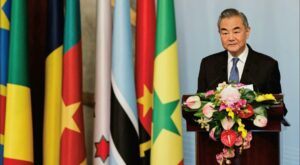
Last year, Chinese Foreign Minister Wang Yi, who is also a member of the Political Bureau of the Communist Party, visited four countries in Africa as part of the strategic traditional annual “Africa first” initiative. He was in Namibia, the Republic of Congo, Chad, and Nigeria between January 5 and 11, 2025. The main purpose of the visit was the scheduled implementation of the outcomes of the Forum on China-Africa Cooperation (FOCAC) summit, which was held in September 2024 in Beijing.
Hosted by President Xi Jinping, the FOCAC summit was attended by Nigerian President Bola Ahmed Tinubu and other African heads of state. The focus of the summit was deepening practical cooperation across the board for sustained and substantive growth of China-Africa relations.
Reviewing his visit to Nigeria, Yi stated upon arrival that he was in Nigeria to reinforce relations between China, Nigeria, and Africa and deliver on the understanding reached at the FOCAC Beijing summit of the previous year. He also had bilateral meetings with President Tinubu and Nigeria’s Foreign Affairs Minister, Yusuf Tuggar, where the two top diplomats discussed the major milestones achieved in China-Nigeria relations under the guidance of President Xi Jinping and President Bola Ahmed Tinubu.
According to Yi, the first major milestone was achieving a new leap in bilateral relations between the two countries when the two heads of state jointly elevated China-Nigeria relations to a Comprehensive Strategic Partnership. The second was the establishment of a new platform for solidarity and cooperation, and the successful convening of the first plenary session of the China-Nigeria intergovernmental committee. Third was the collaboration by the two sides to closely coordinate on regional and international issues, working together to advance the collective rise and development of the Global South.
This year marks 55 years since the establishment of diplomatic relations between Nigeria and China. Analysts noted that over the past five decades, relations between the two countries stand as a successful model of South-South cooperation and a benchmark for China-Africa Cooperation.
Prior to establishing diplomatic ties with China, Nigeria was among the over 180 countries that fully supported the resumption of China’s legitimate seat at the United Nations and the removal of the then illegitimate occupiers of the seat. Subsequently, in 1971, Nigeria solemnly pledged in the joint communiqué recognizing the Government of the People’s Republic of China as the sole legitimate government representing the entire Chinese People, including the Taiwan region. Since then, the One-China Principle has been firmly supported by successive Nigerian governments, serving as the cornerstone for the healthy and stable development of the two countries’ relations.
Verifiable statistics show that, by November 2025, bilateral trade volume between Nigeria and China reached over $22.3 billion, surpassing that of 2024, representing a 30 percent increase. Nigeria is China’s largest engineering contracting partner in Africa, the second largest exporting market, third largest trading partner, and major investment destination in Africa.
According to Prof. Sheriff Ghali, Head of Contemporary China-Africa Research in Nigeria, China-Nigeria relations can be strengthened through more commitments to mutual security, poverty reduction, literacy, Africa’s industrial production, diversification of African economy, anti-corruption campaign, scientific and technological knowledge, digital economy, modernization and massive infrastructure build-up, improved living standards, and improved export economy. He noted that these can be achieved through China-Africa cooperation, co-production, and mutual assistance.
Corroborating Prof. Ghali’s position, Global South experts noted that Nigeria, being a pioneer member and partner of China’s institutionalized mechanisms – FOCAC, Belt and Road Initiative, and BRICS, has been reaping the fruits of its strategic partnership and collaboration with China in opening up new frontiers of socio-economic partnerships between the two countries that will ultimately fast track Nigeria’s national development in a more pragmatic way.
STRATEGIC SIGNIFICANCE AND ACHIEVEMENTS OF CHINA-AFRICA COOPERATION:
In furtherance of deepening cooperation with Africa and in line with the annual traditional diplomatic shuttle to African countries by the Chinese foreign minister, this year the Chinese Foreign Minister Wang Yi, who is also a member of the Political Bureau of the Communist Party of China Central Committee, visited Ethiopia, Tanzania, and Lesotho on the invitation of the countries’ leaderships between January 7 and 12, 2026.
According to the experts on the Global South, the traditional overseas diplomacy to Africa at the beginning of every year underscored the importance of deepening mutual trust between China and African countries, noting that among the objectives of the trip this year was implementing follow-up actions from the 2024 Beijing FOCAC summit.
However, emphasis was also on facilitating exchanges and mutual learning between the two great civilizations of China and Africa. These goals serve as key factors to inject fresh impetus into building an all-weather China-Africa community with a shared future for mankind.
In Ethiopia, Yi attended the launching ceremony of the China-Africa Year of People-to-People Exchanges at the headquarters of the African Union in Addis Ababa along with the AU Chairman, Mahmoud Ali Youssouf. While addressing participants at the event, Yi read out a congratulatory letter from President Xi Jinping, describing the launching as an important initiative jointly agreed upon by the Chinese and African leaders. It was not a coincidence that the ceremony held at a time China and Africa are celebrating the 70th anniversary of diplomatic relations between China and African countries, reinforcing Beijing’s tradition of beginning each year with a diplomatic shuttle to Africa.
According to the Concept Paper of 2026 China-Africa Year of People-to-People Exchanges, China and Africa will carry out wide-ranging activities throughout the year, covering education, culture, tourism, publishing, sports, science and technology, people’s livelihood, and green development, pooling the strengths of youths, women, media, and think tanks, and mobilizing resources at sub-national and governmental level.
Year 2025 also marked the 25th anniversary of establishing the Forum on China-Africa Cooperation (FOCAC). The forum was unveiled in October 2000 in Beijing by the Chinese and African leaders as a platform for collective dialogue and pragmatic cooperation aimed at fostering stronger political, economic, and social ties, promoting South-South cooperation, and aligning development goals through summits and action plans. It has since become a significant mechanism for China-Africa relations.
Since its establishment, cooperation between China and Africa remained solid and consistently yielding fruitful results in areas of infrastructure development, industrialization, financing, among other areas. Experts noted that as at November 2025, total trade volume between China and African countries reached $300 billion, reaching its highest peak since the establishment of the forum, with a cumulative growth of over 20 times compared to year 2000 figures. With this, China has maintained its position as Africa’s largest trading partner for 16 consecutive years.
It is also worthy to know that under FOCAC and Belt and Road Initiative platforms, Chinese enterprises facilitated the building, construction, and upgrading of over 10,000 km of railway networks, 100,000 km of paved roads, close to 1,000 bridges, and about 100 seaports across the African continent. Significantly, these projects have accelerated modernization in African countries and coordinated economic connectivity and development.
In a latest development, beginning December 2024, China has graciously granted zero-tariff treatment on 100 percent of tariff lines to all the least developed countries that have diplomatic relations with China, including 33 African nations. Similarly, China last year announced that it would grant 100 percent zero-tariff lines to the 53 African countries with which it has diplomatic relations.
DEEPENING BILATERAL RELATIONS WITH ETHIOPIA, TANZANIA, AND LESOTHO:
The choice of East African countries and one from South Africa this year was strategic. Ethiopia is China’s traditional largest trading partner with trade volume exceeding $13 billion. It is also a home to many Chinese investments, with exports and imports growing between the two countries.
During his bilateral meeting with Prime Minister Abiy Ahmed, Wang Yi discussed strengthening of China-Ethiopia relationship. The two sides highlighted the existing cooperation in infrastructure, green development, digital economy, and Belt and Road Initiative, as well as outcomes of the 2024 FOCAC Beijing summit.
Ethiopia and China have enjoyed a strong relationship for decades, further to its elevation to an all-weather Strategic Cooperative Partnership. Ahmed and Yi also discussed deepening cooperation in the economy, trade, infrastructure, energy and transportation, as well as tapping the potential for collaboration in emerging fields such as e-commerce, the digital economy, artificial intelligence and green energy.
In Dar-es-Salaam, Tanzania, the aims of this year’s visit were to strengthen bilateral relations between the two countries within the Comprehensive Strategic Cooperation Partnership Framework. This seeks to enhance further cooperation by deepening ties and exploring new opportunities in areas of mutual interest.
President Samia Suluhu Hassan spoke highly of the four major global initiatives proposed by Xi, saying that Tanzania stands ready to enhance multilateral coordination with China and jointly promote a more just and equitable global governance system.
Tanzania is one of China’s largest trading partners with bilateral trade volume reaching $8.8 billion.
Undoubtedly, Lesotho as a landlocked small South African country needs Chinese assisted infrastructure development to booster its economy. In his meeting with the Chinese foreign minister, President Ntsokogane Matekane noted that Chinese enterprises in his country have been producing tangible results.
China and Africa have come a long way. Relations between the two sides will continue to flourish on basis of mutual respect and understanding in the interest of the over 2.8 billion people. Relations will continue to be durable, adaptive and grounded for the community with a shared future for mankind.
African proverb says: “There is no better mirror than a best friend”.
— Lawal is an Abuja based Global South Affairs Analyst and Publisher of Global South Focus (lawalmaida1@yahoo.com)