


By Professor Sheriff Ghali Ibrahim
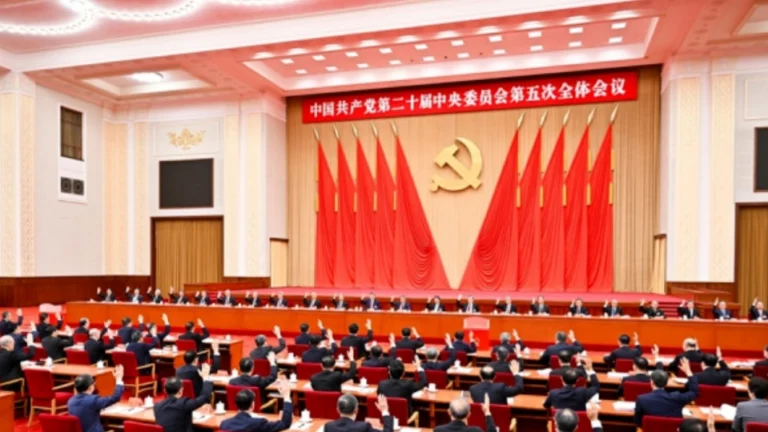
The Communist party of China differentiates itself from all other political parties in the world in terms of formation, development, resilience and in crafting developmental paths. This is evident in its leadership, organizational setting, discipline, tenacity and knowledge for development. Pundits may generate some referential documents and evidential proofs from the 20th Central Committee of the Communist Party of China, which convened its fifth plenary session in Beijing from October 26 to 29, 2026.
As a significant and highest political meeting of the leadership of the Communist Party, a total of 162 members and 117 alternate members of the Central Committee attended the session. What distinguishes China from all other countries in the world is that, the way and modus China fights corruption is impactful and that is the rationale behind coopting Members of the Central Commission for Discipline Inspection to be part of the plenary session as non-voting members. Other leading officials from relevant departments were present at the meeting in a non-voting capacity with a great number of experts and scholars, serving as delegates to the 20th National Party Congress, also attended in a non-voting capacity.
Some of the resolutions of the communique, have rather strengthened the idea that the Communist Party of China is mass-based and hinged on the tenets of its people. Its deep-rooted history has shown emphaty to the people, struggle and victory. The party has struggled to maintain and sutain that legacy and with all strength and energy, members are being indoctrinated to uphold these guiding perinciples.
When the world has been cautioned about communism and the communists, they have been described as obsolete and ideologically not-fit in the contemporary world system, China has shown otherwise and has proven that the fight against communism especially with Chinese characteristics is Chinaphobia. It is in line with the above that the meeting discussed what kind of long-term governing Marxist party China should build and how it should be built? It is same idea used by President Xi on party building alongside Marxist teachings. This has advacnced a major achievement in advancing the Party’s theoretical innovation through the integration of the basic tenets of Marxism with China’s specific realities and its fine traditional culture.
The plenary session also addressed the issue of party governance in a way it will perpetuate profound changes in global, national, and Party conditions for uniting and leading the people in safeguarding China’s sovereignty, security, and development interests, of uniting and leading the people in promoting reform and development and maintaining social harmony and stability, and of maintaining its advanced nature and integrity.
The session went into retrospect to recognise the theoretical foundation of the country as inunciated and advanced by previous Chinese leaders in preserving rigorous Party self-governance to promote the legacy of upholding Marxism-Leninism, Mao Zedong Thought, Deng Xiaoping Theory, the3D Theory of Three Represents, and the Scientific Outlook on Development. It considered fully implementing Xi Jinping Thought on Socialism with Chinese Characteristics for a New Era, and thoroughly study and apply Xi Jinping Thought on Party Building. The concept of party building in the new era is quality party building to enhance the leadership, expansion and management of the party as a political organization.
The concept of party building also connotes strengthening the Party spirit of Communists; strictly practicing democratic centralism; cultivating high-caliber officials capable of shouldering the mission of national rejuvenation; building a well-knit organizational system characterized by cross-level alignment and effective implementation; improving conduct and tightening discipline on an ongoing basis; taking firm and coordinated action against corruption; running the Party with systems and regulations; refining Party and state oversight systems; and ensuring all responsibilities of Party self-supervision and self-governance are fulfilled in earnest.
One of the major problem of human existence is unequivocally corruption, as it destroys legacies, undermines national and international laws, makes societies moribund and deters the spirit of development. It was pointed out that improving conduct and tightening discipline are effective measures to advance full and rigorous Party self-governance. It was noted that taking integrated steps to ensure that officials do not have the audacity, opportunity, or desire to commit corruption is both an important strategy for full and rigorous Party self-governance and a fundamental guideline for our fight against corruption. The Party tolerates no corruption, as it has no special interests of its own besides the interests of the working class and the greatest possible majority of the people.
In a blue print on how party governance can be achieved, it was noted that, the party constitution must be upheld as the fundamental code of conduct for all Party members, institutional reforms must be deepened and integrate law-based governance of the country and regulation-based self-governance of the Party, thus providing strong institutional support for persevering with full and rigorous Party self-governance.
The session highlighted the significance of fulfilling this year’s main goals and tasks for economic and social development and secure a good start for the 15th Five-Year Plan period. China will adhere to the general principle of pursuing progress while ensuring stability; fully and faithfully apply the new development philosophy on all fronts; move faster to foster a new pattern of development; make full and proper use of macro policies; tap deeper into the potential of domestic demand; further deepen reform and opening-up; and pursue sustained and high-quality economic growth driven by innovation. In an effort to ensure security while pursuing development, China will press ahead with initiatives to see that public services are inclusive, meet essential needs, and provide a cushion for the people most in need, and deliver better results, safety, disaster prevention, mitigation and relief, food and drug safety, as well as social stability.
The above calls and resolutions are an obligation for all citizens of China led by the Communist Party to adhere to the tenets of the resolutions. Party members are to rally more closely around the Party Central Committee with Comrade Xi Jinping at its core and fully implement Xi Jinping Thought on Socialism with Chinese Characteristics for a New Era; forge ahead with dedication and enterprise, persevere with full and rigorous Party self-governance, and continually break new ground in supervising, governing, developing, and strengthening the Party; and unite and lead the Chinese people of all ethnic groups in a tireless effort to build China into a great modern socialist country in all respects and advance national rejuvenation on all fronts through Chinese modernization.
In conclusion, with the above resolutions, ethnic tension, political rivalry, corruption, poor governance and absence of party discipline have been deterred, and surmounted. China has grown beyond expertise in party and national governance sterategies, but expands its traditional philosophy to encapsulate global governance intiative, which is the framework of the Communist Party. It sufices to assert that the Communist Party of China, is indeed one of its kind, a paragon and a leading political party in contemporary governance system. China does not place itself on this position, but observers and experts are of the conviction that there is no political party as unique as the CPC in its drive to strategies, selfless comitment to national, regional and global prosperity and development.
— Prof. Ibarahim is Provost, Anti-Corruption Academy of Nigeria, and Head of Contemporary China-Africa Research. (Email: sherfboy@yahoo.com)

Comments