
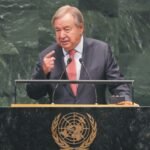




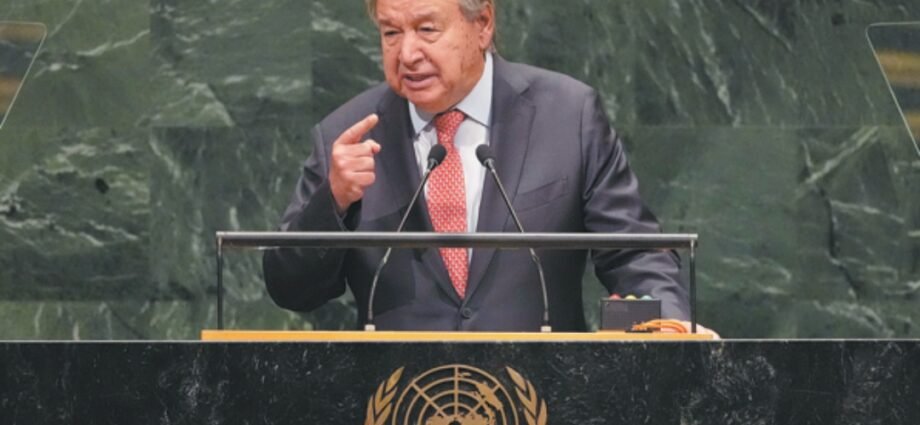
UN Secretary-General Antonio Guterres pleaded for “a world built on interdependence” in his address on Tuesday to a yearly gathering of world leaders convening to face a formidable menu of challenges — from climate change and war to inequality and artificial intelligence.
The UN chief has long urged leaders not to give up on cooperation and shared decision-making amid accelerating global challenges and increasing power competition.
Tuesday’s message at the UN General Assembly took on additional urgency because he leaves office at the end of this year.
“The fault lines in our world are widening,” he said, citing raging wars, rising temperatures and artificial intelligence, among other matters. Instead of letting the future continue to veer toward fragmentation, transactionalism and mistrust, he called for “a world built on interdependence — and sustained by a dense web of economic, political, social and technological connections”.
“Such a world can help us avoid hegemonic tendencies and also what I have called the Great Fracture: the division of the world into two rival blocs with separate economic, technological and security systems,” he said. “A networked world recognizes that no power can solve today’s challenges alone.”
Building such a future begins with a recognition, especially by superpowers, that their power is not so super, that their power has limits. The events of recent years have made that unmistakably clear. Military power alone cannot secure peace. Economic power alone cannot command stability. And technological power alone cannot guarantee security, he said.
His speech opened the main portion of the world’s biggest diplomatic meeting of the year. Leaders from the UN’s member countries addressed each other and the international community and aired their hopes, plans and grievances.
The general debate of the 81st session of the UN General Assembly opened at the UN headquarters in New York on Tuesday. Khalilur Rahman presided over the opening of the debate.
In his opening speech, Rahman stressed the importance of rebuilding trust. Rahman said UN member states have an opportunity in this session to show they have learned from what works, are prepared to confront what does not, and can build a United Nations capable not simply of surviving change, but of shaping change.
Greenland deal inked
At a ceremony on the sidelines of the debate, the United States, Denmark and its autonomous territory of Greenland signed an agreement in New York to expand the US military presence on the strategic Arctic island.
The agreement was inked by US President Donald Trump, Danish Prime Minister Mette Frederiksen and Greenland’s Prime Minister Jens-Frederik Nielsen.
Greenland’s official responsible for foreign affairs, Mute B. Egede, described the agreement as a historic achievement.
Speaking to KNR after the signing, Egede said Greenland must be consulted about its requirements before new military bases were established.
Meanwhile, Ukrainian President Volodymyr Zelensky said on Tuesday that he discussed with Trump efforts to end the 4-year-old conflict with Russia, including a potential bilateral ceasefire on energy-related targets.
Venezuela’s Acting President Delcy Rodriguez also said on Tuesday that she had concluded a meeting with Trump.
Rodriguez described the meeting on the sidelines of the assembly in the US as “historic” in a message on X, posted alongside a photo of the two leaders smiling.