









Vehicle-to-grid trials are expanding across China, signaling a shift from demonstration projects toward large-scale deployment and a growing role for electric vehicles in helping the power grid handle peak demand.
In Shanghai, a V2G discharge exercise on Sept 12 reached a peak response capacity of 34,600 kilowatts and delivered 5,856.77 kilowatt-hours of electricity to the grid over 410 discharge sessions, according to State Grid Shanghai Municipal Electric Power Co.
For the first time, privately owned charging piles provided the majority of the response, accounting for 81.25 percent of the discharge sessions and 65.67 percent of the electricity supplied to the grid. Public charging stations had dominated previous exercises, the company said.
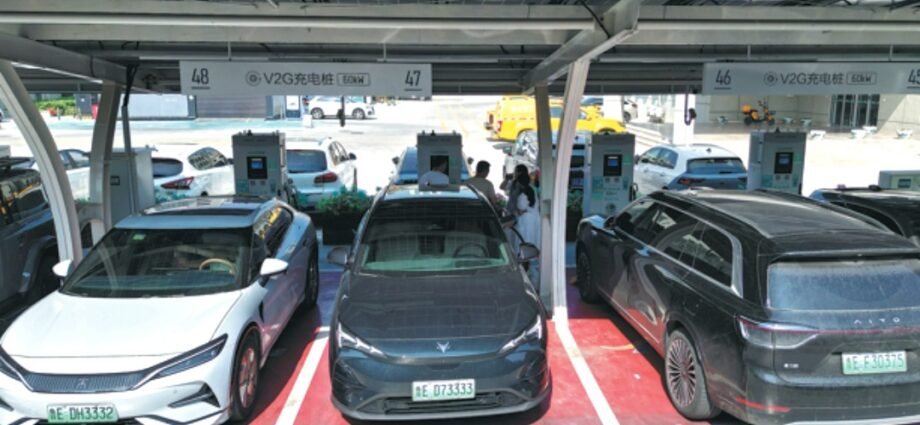
V2G allows vehicles to supply electricity back to the grid when demand rises. Virtual power plants can coordinate large numbers of vehicles.
China’s plan for building a new power system during the 15th Five-Year Plan (2026-30) period calls for the large-scale use of smart, orderly charging and bidirectional charging. By 2030, the country aims to raise aggregated flexible charging capacity for vehicle-grid interaction to 50 million kW.
State Grid Corp of China estimates that if 10 percent of the country’s new energy vehicles participate in V2G programs by 2030, they could provide up to 86 million kW of capacity to help match electricity supply with demand.
From August 2025 to March 2026, a V2G pilot program in Hubei province recorded more than 21,000 discharge transactions, with over 376,000 kWh of electricity supplied to the grid. On July 1, the province began a one-year trial of a V2G pricing mechanism in Wuhan, its capital, for electricity sold back to the grid.
Guangzhou, Guangdong province, held its first regular V2G demonstration event in May, with 492 charging and battery-swapping units across 76 stations feeding 15,000 kWh into the grid.
Liu Yongdong, deputy secretary-general of the China Electricity Council, said wider V2G adoption could turn electric vehicles into flexible grid resources, strengthening the grid’s ability to handle peak demand and respond to emergencies without requiring a corresponding increase in generation capacity.
Battery degradation remains a key concern among EV owners. Liu said that most privately owned EVs are charged 50 to 100 times a year, while their batteries are generally designed for 2,000 to 3,000 charge cycles. Over a 10-year vehicle life, that leaves considerable room for additional charging and discharging through V2G, he said.
Liu added that battery management systems and mobile apps used in current V2G pilots can keep batteries charged between 20 and 80 percent, helping limit degradation and safety risks.
Pricing and settlement rules remain another barrier to wider commercial deployment. Under current electricity-market arrangements, V2G participants pay transmission and distribution charges on the electricity used to charge their vehicles, but those charges are not offset when electricity is later fed back into the grid.
A lack of unified communication standards can create compatibility problems between vehicles and chargers from different brands. Operators face high costs in retrofitting chargers for bidirectional operation. Concerns over warranty obligations and resale values have also made automakers cautious about developing V2G-capable models.
Yang Zhongping, deputy secretary-general of the China Association of Automobile Manufacturers, said scaling up V2G programs would require automakers, grid companies, charging operators and government authorities to work together to establish common technical standards, address user concerns and develop viable business models that benefit all parties.