











By Okoh Aihe
For the policy makers, regulators and industry leaders that gathered in Abuja last week for the Seventh Ordinary Session of the African Telecommunications Union (ATU) Conference of Plenipotentiaries, the message was clear: the need for deeper collaboration, strengthening of relationships and sharing of peer regulatory experiences in order to give the continent a deserved place in the global digital ecosystem.
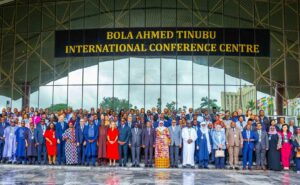
The constant message from Nigeria which hosted the event was the call for greater unity among African nations to advance shared priorities and strengthen the continent’s influence in international decision-making processes, especially with Africa seeking a stronger voice in shaping the future of global telecommunications and digital innovation.
Just as Secretary-General of the International Telecommunications Union (ITU), Doreen Bogdan-Martin, gave credence to the continent’s aspirations as she called for stronger African participation in shaping the global digital agenda, encouraging the continent to become a creator, innovator and contributor to future technologies and standards.
Particularly at this time that the spirit of xenophobia seems to hold the continent by the seams and threatening to rip relationships apart, the rallying cry from Nigeria and actively supported by other countries, was that no one country could go on the journey alone and harvest digital successes.
Vice President of Nigeria, Senator Ibrahim Shettima, puts the message very succinctly. Africa, this presents both an enormous opportunity and a profound responsibility. No single nation, regardless of its size or resources, can fully realise Africa’s digital ambitions in isolation. Our future depends on collaboration,” he said at one of the sessions, through Senator Ibrahim Hassan Hadeijia, Deputy Chief of Staff to the President, Office of the Vice President.
Dr Bosun Tijani, who is the Minister of Communications, Innovation and Digital Economy equally reiterated the position of the vice President when he reaffirmed Nigeria’s unwavering commitment to working with the Union in advancing regional digital integration, innovation and sustainable socio-economic development across Africa.
However, the African Plenipot which brought policy makers, regulators and telecom industry leaders under one roof, is a precursor to the global Plenipotentiary holding in Doha before the end of the year, and was called essentially for African nations to take common positions on building out digital facilities and relationships across the continent and also, at global fora, take common positions on nuanced digital developments and tech inventions, and how they benefit Africa in the long run.
Speaking at the Regulators Roundtable under the theme, Building Africa’s Network Intelligence Ecosystem for Evidence-Based Regulation, Executive Vice Chairman (EVC) of the Nigerian Communication’s Commission (NCC), Dr Aminu Maida, observed, most frankly, that although regulators operate within different market environments and legal frameworks, they face many common challenges, including infrastructure development, cybersecurity, affordability, satellite services, resilience of networks, and the rapid emergence of artificial intelligence technologies.
“Very often, the challenge one regulator is trying to solve has already been encountered, in one form or another, by a colleague elsewhere on the continent,” Maida said.
The Regulators Roundtable is a major programme at the African Plenipot. This year’s edition, according to Maida, provided the “opportunity to consider how better use of data, evidence and market intelligence can strengthen regulatory decisions, and how African regulators can learn more systematically from one another.”
Rimini Makama, Executive Commissioner, Stakeholder Management at NCC, who chaired the Roundtable, noted that “developments such as broadband expansion, satellite services, artificial intelligence, cloud computing and digital public infrastructure are making communications ecosystems increasingly complex and requiring regulators to move beyond traditional regulatory approaches.”
However, the gathering took some other major decisions to strengthen Africa’s position in the years ahead. During the elections, Engr. Kezias Kazuba of the Republic of Zambia was elected ATU Secretary-General to replace John Omo who is serving out his term by the end of the year.
Summarising the election of his country’s candidate and the general conference atmosphere, Felix C. Mutati, Minister of Technology and Science, Zambia, observed that “the Conference was conducted in the spirit of Ubuntu: that we are one Africa, pursuing the same destination and seeking to change the lives of our people.”
Nigeria’s Bosun Tijani who assumed the Chairmanship of the Conference of Plenipotentiaries on behalf of Nigeria, confessed that “every discussion, every decision and every compromise has reflected a shared commitment and belief that Africa’s digital future is stronger when we work together.”
The Conference of Plenipotentiaries is a formal international meeting attended by representatives who have been given full authority by their governments to negotiate, make decisions and sign agreements on behalf of their countries. In the telecommunications context, this usually refers to the International Telecommunications Union Plenipotentiary Conference, the ITU’s highest policy-making conference. The same applies to ATU members that just attended the just concluded Conference of ATU in Abuja.
At the Plenipot, things happen. Far-reaching decisions are made and nations and regions make long arguments to profit from such decisions. The nations that gathered in Abuja pursued the path of oneness and more collaboration to enable the continent profit from modern digital governance and policy-supported expansion of digital services across platforms and borders.
This is a perfect way of saying there is no place for xenophobia in technology and the countries that gathered in Nigeria voted to maintain oneness at international fora in order to make the best digital choices for the continent as one entity.